
Opinion article submitted by Paulie
Carrie Sheffield writes:
Don’t get me wrong, I enjoy Cato Unbound as much as the next supply-sider. But I don’t understand why it’s not uncommon that libertarian candidates play spoiler to Republican candidates. Too often this throws the race to a Democrat who’s much farther removed from the libertarian’s ideology than the GOP candidate.
Ms. Sheffield assumes incorrectly that Democrats are farther removed from libertarian ideology than are Republicans. In reality, Democrats pay lips service to some libertarian ideas and Republicans to others, but neither one is close to being libertarian. Broadly defined, public policy is usually divided into foreign policy, social issues and economic issues. On two out of those three, social issues and foreign policy, Democrats usually try to make themselves sound marginally more libertarian than do Republicans. And even on economic issues, far from supporting any kind of free market, Republicans frequently line up on the side of big business in its attempts to use big government to give itself an economic advantage over everyone else.
Just as Democrats fail to live up to their quasi-libertarian rhetoric when it comes to peace and civil liberties, Republicans fail to live up to theirs when it comes to small government and free markets. Bill Redpath writes in part of his review of Dr. Ivan Eland’s Recarving Rushmore: Ranking the Presidents on Peace, Prosperity, and Liberty:
…[W]hat really struck me, as I reviewed Dr. Eland’s presidential rankings, was how low recent Republican presidents were on his PP&L [Peace, Prosperity & Liberty] scale. I know some people will dispute this, but Eland ranks Ronald Reagan as #34 (landing him in Eland’s “Bad President” category), and he has sensible reasons. Eland claims that the Iran/Contra scandal was worse than Watergate, Reagan did not reduce big government, started “surreptitiously” raising taxes soon after his 1981 tax cuts were enacted, and helped keep Social Security limping along in 1983 (with tax increases, of course) when he could have worked to privatize it. Dr. Eland also thinks Reagan’s role in ending the Cold War was overblown, and that the Soviet Union failed largely on its own. Other low recent Republican president rankings (W. at #36, H. W. at #33 and Nixon at #30) are no surprise.
What is somewhat surprising is that Dr. Eland ranks Jimmy Carter as “The Best Modern President” at #8 (restrained foreign policy/evenhanded Middle East policy/deregulated industries/appointed Paul Volcker to the Fed, who then slayed inflation). Eland even ranked Bill Clinton as the 11th best president on his PP&L scale, so he thinks that over the last forty years, Democratic presidents have actually been more libertarian than Republican presidents.
According to Dr. Eland, to find a Republican president who ranks higher in his PP&L rankings than Jimmy Carter, one must go all the way back to Warren Harding.
Sheffield continues,
Over at Reason, Matt Welch identified seven congressional cases last year where the libertarian candidate garnered more support than the margin between a victorious Democrat and vanquished Republican.
Welch corrects her:
As telegraphed by the use of the scare-quote “‘Spoiler'” in my headline, having third-party candidates beat the margin of victory does NOT mean that they threw the election to the winner. To arrive at that conclusion you need to not only assume that votes by definition belong to one of two major parties (an assumption that I will go along with for the moment), but also to have some idea of who they would have voted for (if anyone) had the third-party candidate not been on the ballot.
To that effect, this follow-up Nov. 16, 2012 post of mine applied a formula derived from a Reason-Rupe pre-election poll of Gary Johnson supporters (who leaned 53% Republican, 38% Democrat, 10% independent) onto eight congressional races that had been flagged as possible LP spoilers in a Daily Kos chart. My conclusion?
[A]s best as I can calculate–there are no spoilers in the chart above. Obviously, there are reasons to believe that the 53-38-10 formula is flawed, but (unlike the implied 100-0-0 number people sometimes use to divvy up third-party votes), at least it’s based on real polling data.
With a year’s hindsight, I would amend that to say you can begin to make a convincing LP-spoiler claim in exactly one 2012 congressional race: Democrat John Tierney’s 48.2%-47.2% win over Republican Rich Tisei in a Massachusetts 6th district race where Libertarian Daniel Fishman received 4.6% of the vote. So there you have it: 435 members of Congress, 33 senators, 13 governors, and one president were elected in November 2012; of those 482 electoral outcomes only one (to the best of my knowledge) can be plausibly argued to have been affected by an LP candidate.
Sheffield then writes
The most recent glaring case in point is the Virginia gubernatorial race, where governor-elect Terry McAuliffe (47.6 percent of the vote) could have lost to Republican Ken Cuccinelli (45.4 percent of the vote) were it not for Libertarian candidate Robert Sarvis, who won 6.6 percent of the vote.
Welch corrects her again:
Here’s an important point for those trying to blame Sarvis voters for throwing the election to Terry McAuliffe: Sarvis voters didn’t throw the election to Terry McAuliffe. No really, they didn’t. According to CNN’s exit polling unit, “if Sarvis had not been in the race, exit polls indicate McAuliffe would have beaten Cuccinelli by 7 points (50%-43%).” According to ABC News’ analysis, “Libertarian Robert Sarvis, may have made it closer for McAuliffe than it would have been otherwise. Had he not been on the ballot, a third of his voters said they’d have supported McAuliffe – slightly more than twice as many as said they’d have gone for Cuccinelli.” In other words, the whole hook for the column is bogus.
Back to Sheffield:
Yes there’s no way to say all those Sarvis voters wouldn’t have just stayed home or voted for Cuccinelli had Sarvis dropped out.
Actually, as we have seen, not only would they not have all stayed home or supported Cuccinelli, but by a margin of 2-1, the ones who would have still voted would have supported McAuliffe, the Democrat.
And yes it’s true that Sarvis got some extra help from Barack Obama mega bundler Joe Liemandt, which doesn’t smell quite right. Liemandt might have had questionable motives—i.e. helping McAuliffe.
No, it isn’t. Wes Benedict corrects the record: Liemandt gave money to the Libertarian Booster PAC with no strings attached. The Booster PAC, not Liemandt, gave a small portion of that money to help Sarvis get on the ballot. Liemandt played no part in that decision. Wes concludes that
If I wanted to hurt the Republican in Virginia, I would have supported a right-wing candidate who sounded like a Tea Partier — who only talked about cutting welfare, Obamacare, and how bad Democrats are. I would never have helped someone like Robert Sarvis, who talked a lot about social issues that appeal to liberal voters.
Sheffield again:
And there’s evidence to question Sarvis’ libertarian bona fides. He said publicly that he’s “not into the whole Austrian type, strongly libertarian economics,” and he offered support for increasing gas taxes and establishing a “vehicle-miles-driven tax.”
Not all libertarians are fans of Austrian economics. The Chicago school of economics is among the other economic schools favored by many libertarians. Sarvis denies
ever endorsing a mileage tax, which some press reports, including an Oct. 31 article in the National Journal, said could require government-installed GPS devices in cars.
“I listed several items that are closer to user-pays than a sales tax [to fund transportation],” Sarvis said. “In the smear campaign that got turned around to me endorsing the mileage tax specifically.”
Sheffield:
I get that libertarianism is not Republicanism. But in a two-party, winner-take-all system (for better or worse, that’s just the reality), it begs the question why someone committed to a small-government philosophy would knowingly generate a big-government winner.
This presumes that the Republican is more small government than the Democrat. But as we’ve seen already, that is generally not the case. And it isn’t a two party system; we have always had other parties and they have always played a role in pushing their ideas into the mainstream by holding the balance of power in close elections and forcing the larger parties to sit up and take notice.
In the case of Cuccinelli, he stood for some extremely big government policies, especially on social issues:
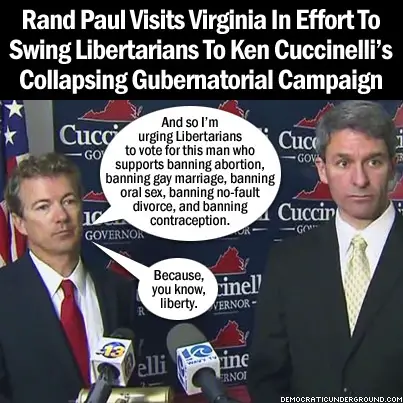
Sheffield seems to think that when it comes to big government, Libertarians don’t mean it, or don’t care as much, when it comes to social issues. But we do!
If a libertarian is running to make a point or shape the conversation, those things can be done effectively without having to push their (narcissistic?) candidacy to the finish line.
We make our point most effectively when we can actually swing the balance of power in close elections. Otherwise, the Democrats and Republicans have less incentive to pay attention to a minority viewpoint that they can eliminate in the primaries and then safely ignore during the general election, when a much larger percentage of the public is paying attention.
Republican Rep. Ron Paul of Texas offers one of the best models of pragmatism and idealism for the libertarian politico. His positions don’t appeal to a national electorate, yet his dogged commitment to the cause inspires his repeated presidential runs. And when he doesn’t win the nomination, he gracefully bows out rather than launching a doomed libertarian venture. Paul also endorsed Cuccinelli…
Sheffield perhaps forgets that Ron Paul ran as the Libertarian Party presidential candidate in 1988, has endorsed other alternative party presidential candidates more recently, and that the disgraceful treatment he received at the behest of Mitt Romney when leaving the Republican presidential nominating convention last year caused him to say he was quitting the Republican Party for the second time. Unfortunately, Ms. Sheffield is correct that Ron Paul also has a long history of endorsing very unlibertarian Republicans, with Cuccinelli being only the latest. The most likely culprit for this in this case is his ambitious son, Senator Rand Paul, along with some misguided Virginia Campaign for Liberty activists.
Of course candidates can do whatever they want. Perhaps they’d have a better chance at litigating electoral case law to create a fragmented, proportional system (although this isn’t necessarily any more functional—I’ve seen this up close as a correspondent covering the Israeli parliament for The Jerusalem Post) than chasing their electoral pipe dreams under our current system.
Electoral reform is a worthy cause, but a difficult one to sell to the general public. We have limited “bandwidth” for getting the public’s attention, and won’t use up all, or most, of it on electoral reform. We’ll keep pushing for liberty – economic and social alike – through whatever electoral system or other means are made available to us. Get used to it.
Bonus graphic, just because:

If you always vote for what you always had (and that includes both Democrats and Republicans) you’ll always get what you always got, and more of it. This old Libertarian campaign commercial makes this point:
http://www.youtube.com/watch?feature=player_embedded&v=tNMPvFZctIA
See also: Paulie: Response to Derek Hunter at Townhall on “The Problem With Libertarians”
The Ron Paul bashing and the Ron Paul idolatry both go way overboard at times.
Jed,
You’re obviously entitled to your opinion, but personally, I couldn’t care less whether Ron Paul (or anyone else) passes some silly litmus test as to what constitutes bigotry.
What I do care about is the way that people treat each other, and I have seen no evidence to suggest that Ron Paul treats gay people any worse than straight people.
I don’t know about that. There are lots of Congressmen, and I’m sure most of them would have loved to have been one of the top 3-4 contenders for the presidential nomination, bring in tens of millions for their campaigns and become “rock stars” on the speaking circuit. If Ron Paul had not been different all those years it’s not clear at all that he would have ever made it this far.
On the other hand, I don’t believe that he has no beliefs. He may tailor his emphasis to his audience, but I think his genuine beliefs are almost certainly in the ballpark of what he says in public.
Most straight guys would probably have a negative reaction to (what appeared to have been) being propositioned by a gay man. I’m not sure that in itself reveals any great degree of bigotry. Someone can support equal rights politically, yet not feel comfortable being put in that position personally. Ron Paul has said he favors so-called “traditional marriage” (in itself a misnomer) but, relatively speaking, his issue stands are less homophobic than many Republican politicians. I’ve heard he is personally homophobic beyond just what the Bruno tape showed, but my sources on that are not very reliable.
Which proves nothing. There are self-hating gays, like Justin Raimondo who claims to be a libertarian while speaking out against same-sex marriage & endorsing Pat Buchanan.
Ron’s “performance” in Bruno proved his homophobia to me. Cohen was trying to get a reaction out of him, but that was the reaction of a bigot.
“Jed Ziggler (@JedZiggler) November 16, 2013 at 12:18 am
I’ve done a lot of thinking on Ron Paul recently. He’s an old-line libertarian, an anti-gay bigot, and a politician,”
That’s an odd accusation to make being that one of Ron Paul’s campaign managers from 2008 was gay.
I’ve done a lot of thinking on Ron Paul recently. He’s an old-line libertarian, an anti-gay bigot, and a politician, though not in the traditional sense. He’s not for me. Not all libertarians suck Ron Paul’s dick, even if we do appreciate the good things he’s done.
“Randy November 15, 2013 at 11:21 pm
The niche for typical politicians is pretty crowded. Claiming a unique niche is a good strategy for standing out from the crowd, and could pay off big.”
If Ron Paul wanted to sell out to the establishment, he’d have done it a long time ago, and he’d be far wealthier than he is now.
Looks like it’s Hate On Ron Paul Day here at IPR. I’ll be the first to admit that he’s definitely not perfect from a libertarian perspective, but the idea that he’s just a typical politician who talks a good libertarian game (like Reagan or Goldwater) is just silly.
If he was really primarily interested in lining his pockets and advancing his political career, he has had plenty of opportunities to do so by “playing ball” with the “GOP Establishment” types, not to mention special interest groups, yet he has repeatedly turned them down, and at times, even gone out of his way to antagonize them. Why would he do that? If he’s just interested in his own political career, why not simply follow the path of least resistance?
As I see it, Ron Paul is a guy who has strong libertarian beliefs on the vast majority of the issues. However, he had a constituency that was more conservative than it was libertarian, so in order to avoid alienating them, he used a lot of conservative rhetoric and spin, while almost always casting his votes in a libertarian, rather than conservative, fashion. In that sense, he’s the exact opposite of Reagan, who talked like a libertarian, but governed like a conservative.
Stop blaspheming! Ron Paul was born of a virgin, walks on water and will rise from the dead.
Paulie,
Exactly.
So, in other words, he is a politician. I’m shocked, shocked I tell you!
True, Ron Paul didn’t vote for DOMA.
Instead, he wrote the Marriage Protection Act, which would have unconstitutionally altered the full faith and credit clause to allow the states to deny equal protection of the law (as, subsequent to the full faith and credit clause, the 14th Amendment forbade) to same-sex couples.
And he bragged about it in his first 2008 presidential fundraising letter. I still have that letter around here somewhere. His three main points were: Stop the queers from getting married, stop the wetbacks from crossing the border, and stop women from having abortions.
Does he really believe those three main points? Maybe, maybe not. He says one thing when he’s in a room full of libertarians with their checkbooks handy, and another when he’s in a room full of conservatives with their checkbooks handy.
Just like he put his name on those newsletter articles, re-affirmed his authorship and defended their content in 1996, then turned 180 degrees and denied authorship and denounced the content in 2006.
And just like he voted against every budget bill, after packing it full of pork for every constituency in his district, then sending fundraising letters to those constituents bragging about how he brought home the bacon, while simultaneously sending fundraising letters to libertarians bragging about how fiscally responsible he was.
We can never know what Ron Paul really believes — if indeed he believes anything. If his lips are moving, he’s probably telling someone what they want to hear, and five minutes later he’ll be telling someone else the exact opposite.
Matt, exactly.
?Ron Paul seems to walk a line between conservative and libertarian that allows his supporters to present (spin?) his positions as either of those philosophies.
I think he spins his positions different ways of different days as well.
Ron Paul supports Gay Rights
http://www.youtube.com/watch?v=U-ZU4Jj6H5A
Ron Paul on Gay Marriage
http://www.youtube.com/watch?v=vH0kHoWdK3M
Ron Paul on Gay Marriage
http://www.youtube.com/watch?v=k3PXANu7mUc
Ron Paul vs. Rick Santorum on Marriage
http://www.youtube.com/watch?v=_fx4tGWHPFg
http://www.rawstory.com/rs/2011/03/07/congressman-ron-paul-says-he-supports-defense-of-marriage-act/
“He voted for DOMA, which did not ban states from passing non-discriminatory marriage laws.”
Uuuggggggg!!!! Ron Paul did not vote for DOMA. He was not even in Congress when DOMA was voted on, so it would have been impossible for him to vote on it.
Ron Paul did voice support later voice support for DOMA, by pointing out that it left the issue of recognizing marriage licenses to the states, however, he also said that the states should not be in the business of licensing marriage in the first place.
George Phillies is correct in attacking Ken Cuccinelli for his anti-freedom stands on abortion and on sexual freedom. Mr Phillies is also correct that Ron Paul stabbed his libertarian supporters in the back by endorsing Mr Cuccinelli.
But Mr Phillies weakens his case by failing to recognize why Ron Paul would have libertarian supporters in the first place.
“Paul’s stands on the menace of immigration, on the so-called “states rights” doctrine, on abortion, on equality before the law for gays and lesbians, and on physical reality (evolution denial, global warming) are much the opposite of libertarian.”
Paul’s stand on immigration is confused, since he has run campaign ads attacking illegal immigration and supporting tougher border enforcement. But whenever he is asked about the issue, he takes a more nuanced stand which includes understanding of the free market position. In one debate during one of his presidential campaigns, he called his vote for the border fence a mistake.
His stand on state’s rights is actually an attempt to avoid stating his own (libertarian) stand on a variety of issues, including drug legalization. Indeed, supporters of medical marijuana have invoked “states rights” in calling for the federal government to leave California dispensaries alone, or dispensaries in the many other states that have passed medical marijuana laws.
Ron Paul has never supported a state’s right to pass mandatory segregation laws, which is what has brought the concept of “states rights” into disrepute.
The Libertarian Party does not have a stand on evolution. As an atheist and an amateur scientist, I certainly believe in evolution, but it is not a political issue except to the degree that governments control our schools.
I also believe global warming is a real issue, but many libertarians do not, and Ron Paul’s views, while they may be wrong, are certainly widely held by libertarians.
Ron Paul’ stand on gay and lesbian issues is also confused. He voted for DOMA, which did not ban states from passing non-discriminatory marriage laws. It gave other states the right to refuse to recognize marriages – questionable indeed – but the conservatives were threatening to amend the Constitution, and DOMA can be more easily repealed than a Constitutional Amendment. Ron Paul did vote to end Don’t Ask, Don’t Tell.
There are many reasons for libertarians to criticize Ron Paul and those around him. But a criticism made based on real libertarian views, not a contentious attack on views that are held by many libertarians, would be a stronger critique.
Good job. And even if there was such a thing as a spoiler (there can’t be since no candidate is promised any votes), I would still vote for whom I thought was the best candidate!
Richard Winger said: “As to Cuccinelli, he also is no libertarian on free speech, because he is trying his best to get the Virginia law reinstated that makes it illegal for out-of-state circulators to work in Virginia.”
Cuccinelli also urged the debate commission in Virginia to increase the polling requirement for candidates to get into the debates for fear of having to debate Rob Sarvis.
Every time anyone sees someone use the word “spoiler”, someone needs to respond by suggesting ranked-choice voting. Those of us who support ranked-choice voting are being given a golden opportunity to spread awareness of that idea, by all this “spoiler” talk.
As to Cuccinelli, he also is no libertarian on free speech, because he is trying his best to get the Virginia law reinstated that makes it illegal for out-of-state circulators to work in Virginia.
A fine example of Republican reality denial is the claim that Sarvis cost Cuccinelli the election. What cost Cuccinelli the election, but not by very much, was his bizarre stands on a long range of issues.
Republicans are the opposite of Libertarian. They are a party of huge government. No, all Republicans are not the same, but neither are all Libertarians. However, Cuccinelli was an opposite of Libertarian. As for his endorser, quoting from the latest Liberty for America:
Reject Congressman Paul
This newspaper has repeatedly warned Libertarians that Congressman Paul is not the libertarian he affects to be. Paul’s stands on the menace of immigration, on the so-called “states rights” doctrine, on abortion, on equality before the law for gays and lesbians, and on physical reality (evolution denial, global warming) are much the opposite of libertarian. Paul’s willingness to pose in front of the flag of slavery while giving a speech defending revisionist fables about the Civil War (with a hat tip to Charles Johnson’s Little Green Footballs web site:
littlegreenfootballs.com/article/39801_Video-Ron_Paul_Gives_Speech_on_Civil_War_in_Front_of_Giant_Confederate_Flag; http://www.youtube.com/watch?v=B85TJJyKyKw) should raise further suspicions.
Now Paul has stabbed in the back every one of his Libertarian Party supporters. In the recent Gubernatorial race in Virginia, Paul has endorsed Republican Cuccinelli for Governor. Politico.com reports “Ken Cuccinelli has always stood for smaller government and limited government,” writes Paul. “He has consistently and unapologetically worked with the Liberty movement in Virginia. “ Paul went on to say that Libertarians who supported our candidate are “insane”.
Paul’s claim that Cuccinelli stands for limited government is a conservative fibbing* point. We’ll consider some of Cuccinelli’s more outrageous giant-government stands below. We first remind readers that toward the end of the Sarvis campaign conservative after conservative put out the claim that their Republican was more libertarian than Robert Sarvis, a concerted effort to save a campaign ship whose bow and stern were both well below water. Paul’s statements should be seen as one more thread in that larger conservative tapestry.
Let us recall Cuccinelli’s anything-but-libertarian stands on few issues. There was the unconstitutional statute he advocated on sodomy, deceitfully opening to sound like a law protecting animals: “§ 18.2-361. Crimes against nature; penalty A. If any person carnally knows in any manner any brute animal, or carnally knows any male or female person by the anus or by or with the mouth, or voluntarily submits to such carnal knowledge, he or she shall be guilty of a Class 6 felony, except as provided in subsection B.: but actually criminalizing what some married couples are said to do in the privacy of their bedrooms. Readers will not be surprised to learn that Cuccinelli also opposes marriage equality.
There was his stand on abortion. The Washington Times, an oft-conservative outlet unlikely to distort his views via exaggeration to damage his name, reported “He opposes abortion in all cases including rape and incest. The only time Cuccinelli supports abortion is when the life of the mother is in jeopardy. Supports new restrictions making abortion clinics follow hospital codes. Supports “personhood” legislation defining life as starting at fertilization. Supports requirement for a woman to have an ultrasound before being allowed to have an abortion.”
Cuccinelli used his office as Attorney General to persecute University of Virginia climate research Michael Mann, a witch hunt that was finally shut down by the state Supreme Court after costing the university’s defense nearly $600,000 in legal fees. Science and Technology are the Glory of the Republic. Real libertarians respect physical reality, which is the opposite of conservative reality denial.
That’s the man that Republican Ron Paul urged people to support. Congressman Paul has shown us his true colors. Good Libertarians should shun him.
States’ Wrongs
If you meet States’ Righters who say states can ignore the Constitution on abortion rights, ask them if they will support States Rights for my state when it ignores the Constitution and bans private firearms ownership. Stand back! Their heads may explode! Libertarians support liberty, not that opposite, the States’ Rights doctrine.
*fib is a very polite euphemism.
“I get that libertarianism is not Republicanism. But in a two-party, winner-take-all system (for better or worse, that’s just the reality), it begs the question why someone committed to a small-government philosophy would knowingly generate a big-government winner.
Sometimes, things must get worse, before they get better. There is no better argument against BIG-government than experiencing BIG-government first hand. That goes for left-wing socialist democrats OR right wing fascist republicans..
This should be required reading for anyone who believes the myth of Sarvis as Democratic plant intended to spoil the election.