
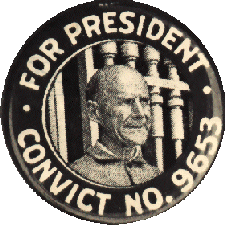
Del. Joseph D. Morrissey was convicted of misdemeanor charges related to sexual activities with a 17-year-old receptionist at his law office, and is currently serving a six-month sentence. He had resigned, prompting a special election, but then he also left the Democratic Party to seek re-election as an Independent.
It is not unheard of for incumbents to run in a special election caused by their own resignation, usually to let the voters vindicate the legislator switching parties and/or continuing to serve after a scandal. Since Morrissey was only convicted of a misdemeanor, he remains eligible to run and serve as a state legislator in Virginia, even while also spending his nights in a county jail that allows him twelve hours each day of work-release.
In a three-way race against both a Republican and a Democratic opponent, Morrissey was re-elected with 42% of the vote. The Democratic nominee polled 33%, and the Republican nominee 24%.
Legislative leaders in both parties have said they intend to take action to prevent somebody casting votes on the floor by day while reporting to prison at night. However, if two-thirds of the members of Virginia’s lower chamber vote to expel Morrissey, there will be nothing to stop him from running again in the next special election.
For more, see this Washington Post article.
This man is a hero! Virtual high five!
Even rape victims – I mean actual rape victims, not cases of manipulation or borderline consent – frequently experience sexual arousal. In fact, many rapists purposely stimulate that response and use it to shame and confuse victims. Both scientific literature and anecdotal reports aplenty on this are easy to find.
Yes, I am aware of this phenomenon, but I don’t see what it has to do with my claim. I’m not saying that arousal = consent, or even that attraction = consent. I’m just saying that arousal is a clear indication of attraction. For example, if you become physically aroused simply from thinking about someone, then you are obviously sexually attracted to them. Of course, that doesn’t necessarily mean that you want to have sex with them. There are many reasons why you might decline to have sex with someone, even though you find them sexually attractive. But it seems obvious that if, for example, a man becomes physically aroused at the thought of having sex with another man, he is sexually attracted to him, and is therefore, by definition, gay (or bisexual). This would still be true even if he had an opportunity to have sex with the other man and, for whatever reason, chose not to do so.
… if I actually believed that most situations fall in the grey areas, that would make libertarianism rather untenable. But I think the grey areas are mostly recognizably on one side of the line or the other…
Again, employing the sort of analysis that you seem inclined toward, I think one could make the case that almost all consent is, at least to some extent, dubious. Take the following example: A man suggests to his wife that they spend a romantic evening together, she eagerly agrees, and they have sex. On the surface, this seems like the textbook example of indisputable consent.
However, what I didn’t mention is that this woman has some serious baggage. As a child, her father frequently accused her mother of not satisfying him sexually, and eventually abandoned their family to run off with a woman who did satisfy him. Similarly, her current husband has a very high sex drive, and divorced his first wife, in part because she couldn’t satisfy it. As if that weren’t enough, this woman has long suffered from a speech impediment, which she was teased about mercilessly as a child,and since getting married and having kids, she has gained quite a bit of weight. Together, these two things have resulted in very low self-esteem, and she is quite certain that if her husband ever left her, she would never be able to find another man.
So, even though her husband frequently requests sex when she’s “not in the mood”, she always eagerly complies, not because she actually wants to, but rather because she is absolutely terrified that if she doesn’t, her husband will leave her and she will spend the rest of her life in loneliness and despair, much as her mother did.
In such a case, I’d say that her consent (which, on its face, appears rock solid) is every bit as “problematic” as that of Pride, wouldn’t you? Furthermore, I’d say if you dug deep enough, you could construct similar arguments in the vast majority of cases. And again, as my drug pusher example above demonstrates, this is certainly not limited to sex. Virtually every decision that anyone makes can be second-guessed, if you are willing to dig deeply enough. In my opinion, however, such second-guessing, far from being compatible with libertarianism, actually undermines the foundations of it, by calling into question whether anyone ever exercises truly genuine autonomy, free from all external constraints.
Clear consent, clearly non-coercive, but appears to be oppressive in a non-coercive way, and so punishable, so to speak, by voluntary means.
Is there some sort of standard for what constitutes “oppressive in a non-coercive way”, or is it simply whatever you personally find distasteful? Also, what sort of “punishment” would you recommend for a case like this, and would you still support the “punishment” even if it violated the wishes of the “victim”?
Sorry, you lost me. I don’t see where you put the shoe on the other foot. You put it on the regular foot it usually goes on. Thick libertarianism might promote the idea that I am being paternalistic and condescending towards Myrna Pride here. I guess that’s one kind of thick libertarianism, not unusual or different from other examples of same. But you twist yourself in a knot by simultaneously decrying thick libertarianism and exercising your own version of thick libertarianism, which you say isn’t just playing devil’s advocate.
I said I wasn’t simply playing Devil’s Advocate, but perhaps my use of the word “simply” was too ambiguous. I meant to say that part of my argument was DA, and part of it wasn’t. Specifically, when I said that I find judgmental moralizing to be off-putting, I wasn’t playing DA. That’s true, and most people (both libertarians and non-libertarians) engage in far too much of it for my taste. (Truthfully, I probably engage in a bit of it myself, but I do try to avoid it). However, that is just my personal opinion, and really has nothing to do with libertarianism, at least not per se.
That brings me to the part of my argument that was DA, which was my claim that, in order to be consistent with the spirit of libertarianism, one has to agree with my distaste for judgmentalism. Perhaps the simplest way to put it would be to say that I don’t really believe in any sort of thick libertarianism; however, if I were forced to advocate some sort of thick libertarianism, it would be of the sort that I have been advocating during this thread. Hopefully, that clarifies things.
My idea of thick libertarianism, however, is not that those who disagree with my cultural values are any less libertarian than I am – only that those cultural values are important, and that libertarianism alone doesn’t address all important problems in society.
My problem is not really with libertarians having (or even promoting) whatever cultural values they choose. My problem is with the attempt to smuggle those cultural values in under the “libertarian” umbrella, or to frame these values as somehow “part” of libertarianism, as I think this necessarily implies that people who disagree with those values are somehow less libertarian, even if you say that’s not your intention. After all, if you say that believing X and promoting the truth of X is “libertarian” then it obviously stands to reason that if two people have identical viewpoints, except one believes in X and the other doesn’t, the one who does believe in X is “more libertarian” or at least “more consistently libertarian” than the one who doesn’t believe in X.
In other words, thick libertarianism (regardless of whether it intends to or not) promotes the idea that in order to be a “real” or “consistent” libertarian, one must do more than simply adhere to the NAP. What I was trying to do was to reverse that, and show that by the same logic (about the “spirit” of libertarianism), you could make the opposite claim: that in order to be a “real” or “consistent” libertarian, one must actually avoid advocating anything other than the NAP. That’s what I meant when I said I was trying to turn thick libertarianism on its head.
Exactly. And now with that out of the way…
https://www.youtube.com/watch?v=nXXZw65wqLo
Paulie – sounds about right to me. Clear consent, clearly non-coercive, but appears to be oppressive in a non-coercive way, and so punishable, so to speak, by voluntary means.
Not really. It was part of my humorous banter with Cholko, not meant to make any serious point.
Yeah, it’s more of a “if you play with fire you may get burned” sort of cautionary tale for any grown men looking at pretty teen girls and fantasizing how nice it would be.
It doesn’t. The points were more serious (my discussions with langa). This wasn’t part of that.
Exactly. He even says that they are supposed to be a sort of illustration of the flaws of thick libertarianism, yet he actually believes them at the same time, all while opposing thick libertarianism. It’s pretzel logic, as far as I can tell.
Thanks; that’s a good summary.
I’d say there was clear consent, and in general I would put the rebuttable line somewhere around puberty (not that puberty is an overnight thing either). I’d still consider a 57 year old employer who screws a teenage employee who has “never had anyone else be nice to her before in her life” as manipulative and unethical, even though she is pretty clearly consenting to it, and even though I would not be in favor of locking him up in jail for doing so.
Paulie – is the clip above meant to demonstrate something? I saw the movie; the guy was an idiot but not a rapist. He didn’t encourage her, he just spent the movie acting like a moron and found out that even young people can be manipulative. I don’t see how it relates to the points you’re making, which I overall agree with.
On a side note, I don’t see how Langa’s comments above are consistent with thin-libertarianism, but that fits my general perception that there are very few actual thin-libertarians in the world. I see both positions being argued here as thick, just in different directions. I generally favor Paulie’s direction in being more open to finding oppression outside of government while also defending our right to fight non-coercive oppression in non-coercive ways, depending, obviously, on the situation. I don’t have enough information in this case to make a determination, but I lean towards 17 is old enough to have a presumption of consent.
https://www.youtube.com/watch?v=Hu5OSkF2oi8
I’m working on that.
I don’t know. Have you screwed two teenage employees yet like I advised you? It will clear your head and make everything make sense. Of course, you could ignore my advice, but I wouldn’t recommend that.
Am I still a libertarian if I disagree with langa’s opinion of Paulie’s opinion of my opinion about his opinion?
That’s actually not proof of anything relevant. Even rape victims – I mean actual rape victims, not cases of manipulation or borderline consent – frequently experience sexual arousal. In fact, many rapists purposely stimulate that response and use it to shame and confuse victims. Both scientific literature and anecdotal reports aplenty on this are easy to find. Add to the mix all of the confused emotions of adolescence in general and manipulative situations that are not clearly rape, and confusion – whether it involves sexual identity or just specific relationships – is very widespread, especially but not only among adolescents and young adults.
Both are separate and distinct, although overlapping, phenomenon. Many people’s sexuality evolves over time. And, separately, at times many people find themselves confused sexually in all sorts of different ways, with conflicting emotions, mixed feelings, attractions and repulsions that they are grappling to understand. In some cases, but not all cases, the same people.
Sorry, you lost me. I don’t see where you put the shoe on the other foot. You put it on the regular foot it usually goes on. Thick libertarianism might promote the idea that I am being paternalistic and condescending towards Myrna Pride here. I guess that’s one kind of thick libertarianism, not unusual or different from other examples of same. But you twist yourself in a knot by simultaneously decrying thick libertarianism and exercising your own version of thick libertarianism, which you say isn’t just playing devil’s advocate.
I usually do as well. And we both acknowledge the existence of grey areas, gradations, etc.
Except when you employ them against others who are also not violating anyone’s consent?
And I said that I have a personal opinion. I thought I made it clear that I don’t think anyone who doesn’t share my opinion of the situation is any less libertarian as a result. The only claims of that nature in this discussion have been against my position.
I understand that’s the shoehorn argument you are trying to make here, but I don’t think you have succeeded.
Which is the opposite of what you said when you said that my opinion goes against the spirit of libertarianism, and now you’ve made it clear you were not just playing devil’s advocate.
My idea of thick libertarianism, however, is not that those who disagree with my cultural values are any less libertarian than I am – only that those cultural values are important, and that libertarianism alone doesn’t address all important problems in society. Which is entirely consistent with my view that moral judgement and persuasion has a place, even when there’s no violation of consent.
Yes, if I actually believed that most situations fall in the grey areas, that would make libertarianism rather untenable. But I think the grey areas are mostly recognizably on one side of the line or the other – I’m just not giving up on moral judgement and persuasion in those cases, nor do I see a functional libertarian society as very tenable without them.
I’ll be the exception then. Male sex workers sometimes get exploited, abused, manipulated, coerced – to one degree or another – just as female sex workers sometimes do.
You’re right, that’s a double standard a lot of people have. I on the other hand recognize that these situations often have elements of sometimes subtle and sometimes not so subtle abuse of power by the older person in a position of authority, regardless of gender.
True of some people, but you are lumping me in with attitudes I don’t share.
Thank you; that was pretty much my point in a nutshell. If we share this agreement, we may just be arguing semantics…or shades. How minor does a minor have to be before it’s not meaningful/informed consent? How mentally ill or mentally retarded? There are no bright lines…no more than someone waking up on their 18th birthday as a whole different kind of person, in reality.
I don’t disagree with you. And I don’t consider all or most things to be functionally in the grey area.
It would, but that’s not my mindset.
I’d hardly say that it’s a sham in anything close to the vast majority of situations. But yes, those arguments do exist, and while they tend to be vastly exaggerated, we are doing ourselves a disservice if we fail to acknowledge that they do have some basis in reality. The best way to deal with that basis is with persuasion, judgement, those sorts of things – exactly the things you say violate the spirit of libertarianism. But the reality is that failing to leave open the grey area of less coercive ways of countering these somewhat but not entirely coercive situations is opening the door to more coercive ways of dealing with them, because reacting to them is part of human nature. If we aren’t allowed to express a negative opinion towards situations where people are being self-destructive or manipulative or abusive or threatening, etc., before it crosses the line into clear initiation of force, it most likely will, in one direction or the other.
If we can’t use persuasion it’s more likely that someone will use force. And that is what opens the door to totalitarianism.
I disagree. Saying that people have no right to judge/criticize other people’s thoughts and action as long as they don’t involve clear initiation of coercion, and at the same time judging/criticizing me for just having and expressing an opinion – I’m not coercing anyone here – is inherently self-contradictory.
Oh, and one more thing: Even though it doesn’t really have much bearing on the rest of this discussion, I don’t really think that people are “confused” about their sexuality, as much as I think that people’s sexuality often evolves over time. I have never understood the claim that they are confused, especially since, in many cases, there are clear signs of arousal that leave little room for doubt about the authenticity of the attraction, at least on a purely physical level.
Finally, I have my own confession to make (albeit of a much different nature than yours). This whole argument about the “spirit of libertarianism” has been basically an intellectual exercise, designed to highlight the flaws of “thick” libertarianism, by turning it on its head. The gist of thick libertarianism is that, in order to be a “real” or “consistent” libertarian, it is not enough to adhere to the NAP; you must also believe in and promote certain opinions on cultural matters. In short, you must engage in the exact kind of judgmental meddling that I’ve been denouncing.
My goal was to put the shoe on the other foot, by making the argument that, far from making one a “real” or “consistent” libertarian, such activities are actually contrary to libertarianism.
Again, one caveat: I wasn’t simply playing Devil’s Advocate. I do believe the things that I have been saying. I do tend to (usually) take consent at face value. Judgmental meddling and sanctimonious moralizing do tend to rub me the wrong way. It’s just that I don’t think that these personal opinions of mine have much (if anything) to do with libertarianism*, nor do I think the cultural values promoted by “thick” libertarians (be they the “left” variety like Roderick Long or the “right” variety like Hans Hoppe) have anything to do with libertarianism. In my opinion, the question of how libertarian someone is boils down to how consistently they oppose the use of aggression. Period. No more, no less.
*That’s true at least of the meddling and moralizing. The consent issue is a bit of a different case. I think one’s view of consent could very well make one more or less of a libertarian, as I tried to explain earlier.
Of course not all sex workers (not all of whom are women either, again of course) are coerced. But it would be equally stupid to believe that none are. It would also be unrealistic to think that there’s a bright line separating the two. Many are emotionally manipulated, sometimes on the basis of past abuse and using mental triggers, sometimes on the basis of being offered bad alternatives, sometimes on the basis of a volatile relationship with someone they genuinely love who is sometimes abusive, and so on. They will often defend the situation as consensual. All of these things exist along multiple continua; there’s no magic age, no magic number of drinks, no magic lines anywhere, only shades of grey.
First, the reason I singled out women is because people who make these kinds of arguments almost always limit them to cases involving women. You almost never hear anyone claiming that male sex workers are being abused or exploited. Similarly, teenage boys who have sex with much older women are rarely described as victims, and certainly not to the same extent as teenage girls who have sex with much older men. In fact, there is clearly a double standard at play here, which regards males as more competent to make their own decisions, while females are perceived as weaker and much more easily manipulated. That’s why I described it as a condescending, paternalistic attitude, specifically directed toward women.
Second, I think we can agree that there are definitely shades of grey. As I mentioned the other day (on the thread about the 17-year-old transgender girl who committed suicide), the NAP is not always easy to apply to certain groups. It was designed to apply to mentally competent adult humans, and there is often disagreement among libertarians as to whether/how it should be applied to other groups (such as minors, fetuses, non-human animals, the mentally ill or mentally retarded, and so forth).
Where I think you and I disagree is how to deal with these various shades of grey. Imagine five categories: pure black, dark grey, medium grey, light grey, pure white. I am personally inclined to consider dark grey to be functionally equivalent to black, and light grey to be functionally equivalent to white. The alternative, I think, is to have almost everything fall in the grey area, since, if you really analyze them thoroughly enough, there are really very few cases that are truly pure black or pure white. You can almost always come up with some (often far-fetched) reason why the validity of someone’s consent could be considered at least slightly disputable.
Furthermore, I think this sort of “everything’s a grey area” mindset makes libertarianism rather untenable. After all, if people are constantly being victimized without even being aware of it, that opens the door for all sorts of government intervention (ostensibly) designed to “protect people from themselves”. For example, the war on drugs could be justified on the grounds that people who use drugs may not be coherent enough to think clearly, and therefore will easily fall prey to being manipulated by the so-called “pusher”, who will take advantage of them in their drug-addled state. I’m sure you don’t need my help to imagine similar arguments to justify all sorts of laws. many of these arguments aren’t even hypothetical. They have long been used to justify all manner of tyrannical laws. Thus, to concede that consent is (in the vast majority of situations) little more than a sham is to open the door to totalitarianism.
I only bristle at double standards. If it constitutes a sort of violation of the “spirit of live and let live” for me to have a personal opinion about someone else’s actions that fall short of initiation of coercion but are IMO somewhat in that direction along a continuum, then it seems to me to be a violation of the spirit of live and let live for someone to have an opinion about my opinion, since I am explicitly not for using force (especially government force) to stop them. But since I don’t think there’s anything wrong with me having an opinion in the matter, I also don’t think it’s wrong for others to have an opinion about my opinion…other than when it falls into the area of double standards.
This issue of double standards is an important one, and I’ll have more to say about it shortly. For now, I’ll just say that I don’t think I’m the one employing double standards.
I can have personal opinions about whether other people’s actions are ethical, just as other people can have personal opinions about whether my thoughts on the matter are reasonable and/or consistent with the spirit of libertarianism, and none of us are interfering with anyone’s right to live and let live just by having opinions. Indeed, allowing all these opinions is integral to live and let live.
I never said you weren’t allowed to have those opinions. I just said that it seemed inconsistent with your professed libertarianism. Similarly, I believe hate speech should be allowed, but it would certainly seem inconsistent for a self-professed egalitarian to engage in hate speech.
So, mea culpa: in college I used to take some young women home with me that were way drunk. They seemed to be OK with it when it happened, but some of them didn’t remember what happened or how they got there the night before in the morning. They had various degrees of regret or being OK with it the next day. I doubt any of them had never been in that situation before doing it with me. I didn’t stay friends with them and we generally barely acknowledged each other if we saw each other again. This happened a bunch of times, and sometimes I would go out to the bars close to closing time, having had little alcohol myself, and purposely look for women that were sloppy drunk and perhaps no longer with who they came down to the bars with, sometimes emotionally unstable, in many cases not within stumbling distance of where they lived and in no shape to drive. I still wouldn’t call what I was doing then rape, but looking back on it, it was unethical.
There’s circumstantial evidence that falls along a continuum. That’s an opinion, and not one I am trying to force on anyone.
No.
It’s not. Many sex workers are in situations which are along the continuum of manipulation, mixed feelings, confusion, feeling trapped, and non-consent. Not all.
Lots of people are confused about their sexuality, whether they identify as gay or straight or some combination thereof, and especially (but not only) in their teen years.
They exist along a continuum as well. Or multiple continua, actually.
I think so, but YMMV. Just as I don’t believe there’s a magic age, I don’t believe in a magic line between consent and non-consent. Clearly, there are things on one side or the other, and much like any libertarian I am all for not using force when there’s consent between adults. But just as there’s no magic line separating children and adults in reality, there’s also no magic line separating consent and non-consent either. There are shades in between on both. Yes, that’s a problem for libertarianism, but it doesn’t make libertarianism invalid, nor does it make the problem any less real. It just makes things complicated. Well, reality is complicated.
Let’s leave age out of it — we can all basically agree that informed consent does not exist when someone is blacked out drunk, correct? But when does someone cross that line? How drunk is too drunk? How can you tell? It doesn’t make it invalid to say that having sex with someone after a few drinks is OK, and that at some point they are drunk enough that it becomes not OK, but it also doesn’t mean that there is a magic point where that happens either. Again, a continuum.
It falls along a continuum. He is much older, in a position of authority as her employer, in a position to give her the independence from a family she is unhappy with, the “first person to be kind to her,” a sort of unofficial surrogate father. I don’t believe in magic ages, so there’s no bright line separating her situation from that of prepubescent children with Uncle Chester, only movement along continua. Some kids who are being molested (even little kids) will have had previous sexual relationships, and they may even defend it after they become older – it all depends on how screwed up they get mentally. I explicitly said she is not nearly as far down that continuum as a little kid being molested, and in my view not nearly far enough for the law to ought to be involved, but yes, far more so in that direction than couples of relatively more equal age and power/status. Even the government’s law acknowledges that this type of thing is not nearly as bad as molesting little kids, and that it involves consent. I think the government’s law is too harsh, but that doesn’t mean I have to think it’s perfectly A-OK on every level.
Why? I have ample experience to realize that people have degrees of subtle coercion, Stockholm syndrome, “acting out” and confused feelings in their lives, especially during the transition from childhood to adulthood.
Of course not all sex workers (not all of whom are women either, again of course) are coerced. But it would be equally stupid to believe that none are. It would also be unrealistic to think that there’s a bright line separating the two. Many are emotionally manipulated, sometimes on the basis of past abuse and using mental triggers, sometimes on the basis of being offered bad alternatives, sometimes on the basis of a volatile relationship with someone they genuinely love who is sometimes abusive, and so on. They will often defend the situation as consensual. All of these things exist along multiple continua; there’s no magic age, no magic number of drinks, no magic lines anywhere, only shades of grey.
Because it’s perfectly natural and normal for people to have opinions about what other people do. If someone wants to blow their paycheck at the casino or drink too much or have meaningless sex with strangers that they regret later or buy clothes they can ill afford I can have an opinion about it without resorting to force. If a much older man in a position of authority has sex with a 17 year old girl who says no one else has ever been kind to her and passes her nude photos around I can have an opinion about it too, even if she says she is OK with it. That doesn’t mean I am going to go beat him up or lock him in a cage or approve of others doing it on my behalf.
You’re certainly allowed to do so. I only bristle at double standards. If it constitutes a sort of violation of the “spirit of live and let live” for me to have a personal opinion about someone else’s actions that fall short of initiation of coercion but are IMO somewhat in that direction along a continuum, then it seems to me to be a violation of the spirit of live and let live for someone to have an opinion about my opinion, since I am explicitly not for using force (especially government force) to stop them. But since I don’t think there’s anything wrong with me having an opinion in the matter, I also don’t think it’s wrong for others to have an opinion about my opinion…other than when it falls into the area of double standards.
Not necessarily. I can have personal opinions about whether other people’s actions are ethical, just as other people can have personal opinions about whether my thoughts on the matter are reasonable and/or consistent with the spirit of libertarianism, and none of us are interfering with anyone’s right to live and let live just by having opinions. Indeed, allowing all these opinions is integral to live and let live.
You didn’t say it was unreasonable, but that has been said by others here, along with the thing about it being inconsistent with the spirit of libertarianism and a few other things.
Probably not. And it’s different when it’s back and forth response versus writing your own epistle, complete with wall of text paragraphs (a personal pet peeve – I plain can’t read long paragraphs, my brain just refuses). I’ll break it up in response sections though, and may or may not get to all of it.
I agree, that is a problem. I found ways around all those restrictions when I was a teenager, but I still found them annoying.
Since I can’t imagine that other sections of the law there don’t address sex between those over 18 and those under 15 years old, or between adults and their children or grandchildren, clearly this law does not treat 4 year olds the same as 17 year olds. I would imagine the penalties for adults having sex with those who are younger than 15 must be more severe. Also, this law section clearly says consensual sex, which implies that those who wrote it understand that teenagers are capable of consenting to sex, even though their judgement in such matters is less likely to be clear than that of adults.
First, I didn’t say that the law treats 17-year-olds the same as 4-year-olds. I said that it recognizes more differences between a 17-year-old and a 21-year-old than between a 17-year-old and a 4-year-old.
Also, I didn’t limit that claim strictly to matters of sex. There are many other ways, such as voting, buying alcohol, buying tobacco, driving, and many more, in which teens are treated more like children than adults.
Your position reminds me of Block’s Defending the Undefendable line of thinking. Such thinking puts L’s on the fringes, as I see it, since my observation is that politics is not just measuring human action by one very narrow consideration: the NAP.
I suspect that most Ls even get that nominating a dude in his 50s schtupping his 17 year old assistant is a bad idea, well beyond just a simplistic NAP analysis.
First, I never suggested that the LP nominate Morrissey.
Second, if you think my position boils down to “the NAP is all that matters” then you obviously missed the point. The gist of this whole notion of thick libertarianism (of which my position could be considered an example) is that if you want to really embrace the spirit of libertarianism, adhering to the NAP is necessary, but not sufficient.
Holy shit. I think I just broke Andy’s record for the longest comment in IPR history! 🙂
So oddly enough, I have actually been very respectful of other people’s opposing viewpoints here, whereas other people have said my viewpoint is unreasonable (I haven’t made the same statement about theirs, nor do I think it is). Try to look at your statement above from that angle and see if you can understand what I mean here. Is calling my viewpoint unreasonable respectful towards my POV?
Where did I say your viewpoint was unreasonable? First, I said I was surprised by it. Later, I said it seemed inconsistent with the spirit of libertarianism. Neither of those is equivalent to saying that it’s unreasonable.
If we are going to seriously tell people that we are offering persuasion as a real alternative to force, we can’t then be mad at people for fully utilizing their powers of persuasion. If we say that individual judgement is to be taken as a real alternative for the state’s use of force to keep everyone in line, we can’t then at the same time say that people shouldn’t use their individual sense of judgement, or we are cutting our own case off at the knees.
I definitely agree that persuasion is a better way of changing people’s thoughts or actions than force is, but what I don’t understand is why so many libertarians (and others, of course) feel the need to change people’s thoughts and behaviors to begin with, so long as those people aren’t harming anyone. In this case, for example, what is wrong with simply saying, “Regardless of the nature of the relationship between Morrissey and Pride, as long as they are both happy with it, it’s really none of my business.” Isn’t that much more consistent with a “live and let live” attitude?
Am I being lectured on how I should think, or is some thinking and some lecturing more “libertarian feeling” than other thoughts and other lecturing?
I’m definitely not lecturing you. As I tried to make clear with my caveats, I’m just expressing my viewpoint (and trying to do so in a respectful fashion) about whether certain attitudes are compatible with the spirit of libertarianism. Self-proclaimed “thick” libertarians do this all the time, and you seem to have no problem with it. I don’t understand why I’m not allowed to do so.
If we can’t use individual judgement, we invite the state or some other authority to take that role on for us.
Again, except in cases of aggression, I’m not sure why anyone has to assume the “role” of passing moral judgments. What’s wrong with each of us simply minding our own business? Why can’t we leave the judgments to God, or karma, or whatever you believe in?
These situations are complicated. But it’s certainly not unheard of for teenagers to act rashly and use bad judgement. Nor is it unheard of for older adults – however, older adults are generally supposed to set the better example and not act impulsively without consideration of consequences. Reading between the lines it seems very plausible that she is confused and vulnerable. It’s an educated guess, not an assumption.
Call it a “guess” or an “assumption” or whatever you like: When you are essentially dismissing the strongly asserted claims of someone with firsthand knowledge of what happened, on the basis of little more than speculation about what could have conceivably happened, I’d call it being disrespectful. It reminds me of when people claim that all sex workers are being abused and exploited, whether they realize it or not. Never mind that many of them profess to be very happy with their job; they’re “obviously” victims of a “false consciousness” or some mental disorder, right? The whole thing reeks of a condescending, paternalistic attitude toward women, who are supposedly so easily tricked and manipulated by clever, cunning men.
I’ve got a live and let live mentality, but that doesn’t mean I lose my ability to judge – in fact, I think it’s integral to live and let live being practically possible, and the only way it could actually work.
Evidently, my conception of a “live and let live” mentality differs considerably from yours (and quite a few other libertarians). To me, such a mentality is based on the idea that as long as no one is being harmed, there is no need for me to go around meddling in other people’s affairs. However, many libertarians seem to feel that meddling in other people’s affairs is perfectly fine, and even laudable, so long as the meddler does not engage in aggression. While I certainly agree that aggressive meddling is far worse than non-aggressive meddling, I frankly fail to see the need for either.
If you want to go down the rabbit hole of solely relying on her word that she was OK with it, you might be surprised, or not, that girls (and boys) much younger than 17, even prepubescent children and even those in the single digit age range, have said they were OK with having sex with adults and defended the relationship (“but I want to stay with Chester…he’s nice to me and buys me candy and toys!”)
I am perfectly aware of all these things, but I fail to see the relevance. We are talking about a 17-year-old who had already been involved in at least one previous sexual relationship (and quite possibly many others), and who, even now having passed the “magic” age of 18, has not changed her story one bit. Are you really claiming this is analogous to prepubescent children being molested by Uncle Chester? Come on, Paulie, you’re a smart guy. You can do better than trotting out such a blatant straw man.
I am not saying she necessarily had to have experienced anything nearly as intense as Patty Hearst/Stockholm Syndrome, but hostages have been known to become sympathizers, defenders and participants with terrorists who held them captive. So if they say it’s OK after the fact does it mean nothing was done against their will, or that their judgement couldn’t have been twisted?
Yet there is no real evidence to suggest she is suffering from any of these things. Is your argument that claims of consent are only valid if the action being consented to is one that makes sense to you? How is doubting this woman’s claims any different than the sex worker example I gave above, or the old idea that gay people (especially gay teens) aren’t really attracted to members of the same sex, but are instead simply “confused” about their sexuality? Are these sorts of arguments also compatible with the spirit of libertarianism? Is it really libertarian to say that the whole notion of consent is basically a sham, as you seem perilously close to doing here?
Don’t hate the player, hate the game.
Take two teenage girls to bed tonight and call me in the morning. It will clear your head and clear your confusion up tremendously.*
* If you have any trouble finding two teenage girls who want to go to bed with you, offer them jobs. That should help improve your odds. During the interview, ask them if anyone has ever been kind to them in their lives. If they say no, use that to your advantage.
Because sexual contact may be ill defined, and open up it up to disputes over what exactly is and is not sexual contact and whether whatever occurred was sexual contact or not.
Take two teenage girls to bed tonight and call me in the morning. It will clear your head and clear your confusion up tremendously.
@paulie. Under 15 is covered by the rape statute. I don’t know what the felony charges he was facing were (probably related to the photos, and/or maybe some kind of provision applying to employers of minors.)
I agree it’s a bid odd to see “consensual sex” in the language, but the whole things is pretty oddly drafted. I wouldn’t expect statutory rape, as it’s commonly called, to fall under “contributing to the delinquency…” Reminds me of Cuccinelli getting tripped up over his support for a similarly explicit law he’d supported. I don’t understand why legislators can’t just say “sexual contact/relations” or something to that effect and leave it at that, but apparently an explicit list of no-no behavior is necessary.
I’m confused. Exactly how must I feel about someone else’s thoughts to be considered a real libertarian? 😉
Since I can’t imagine that other sections of the law there don’t address sex between those over 18 and those under 15 years old, or between adults and their children or grandchildren, clearly this law does not treat 4 year olds the same as 17 year olds. I would imagine the penalties for adults having sex with those who are younger than 15 must be more severe. Also, this law section clearly says consensual sex, which implies that those who wrote it understand that teenagers are capable of consenting to sex, even though their judgement in such matters is less likely to be clear than that of adults.
Apparently, the age of consent in Virginia is 15 if both parties are under 18, but for an 18+ y/o to have consensual sex with an 15-to-18-y/o is still included in the definition of “contributing to the delinquency of a minor.” The law also helpfully describes in surprising detail exactly what kind of sex is not allowed.
https://leg1.state.va.us/cgi-bin/legp504.exe?000+cod+18.2-371
Most laws, and most actual applications of the law in practice, make a distinction between underage children depending on just how underage they are, and sometimes among their above-age sex partners based on just how above age they are. In many cases of actual application individual circumstances are taken into account, although it’s harder to codify that into law.
L: No, I don’t think anyone is “required” to criticize him for advocating the Fair Tax, but if they do choose to do so, I don’t don’t see anything wrong with that. That would not be an example of the “preachy” or “judgmental” libertarianism that I am opposed to.
me: Thanks for clarifying…not required, nothing wrong with…got it.
Your position reminds me of Block’s Defending the Undefendable line of thinking. Such thinking puts L’s on the fringes, as I see it, since my observation is that politics is not just measuring human action by one very narrow consideration: the NAP.
I suspect that most Ls even get that nominating a dude in his 50s schtupping his 17 year old assistant is a bad idea, well beyond just a simplistic NAP analysis.
So oddly enough, I have actually been very respectful of other people’s opposing viewpoints here, whereas other people have said my viewpoint is unreasonable (I haven’t made the same statement about theirs, nor do I think it is). Try to look at your statement above from that angle and see if you can understand what I mean here. Is calling my viewpoint unreasonable respectful towards my POV?
I disagree. If we are going to seriously tell people that we are offering persuasion as a real alternative to force, we can’t then be mad at people for fully utilizing their powers of persuasion. If we say that individual judgement is to be taken as a real alternative for the state’s use of force to keep everyone in line, we can’t then at the same time say that people shouldn’t use their individual sense of judgement, or we are cutting our own case off at the knees.
You may be right. Let’s just go ahead and say you are right. So in this discussion, I wasn’t telling anyone how they should think, just expressing a personal point of view. Whereas other people are telling me that my opinion is not only wrong but actually unreasonable, and that, while not strictly speaking unlibertarian, it doesn’t “feel” libertarian. How can that be? Am I being lectured on how I should think, or is some thinking and some lecturing more “libertarian feeling” than other thoughts and other lecturing?
Well, yes, by definition it is. If we can’t use individual judgement, we invite the state or some other authority to take that role on for us.
I wouldn’t assume it. These situations are complicated. But it’s certainly not unheard of for teenagers to act rashly and use bad judgement. Nor is it unheard of for older adults – however, older adults are generally supposed to set the better example and not act impulsively without consideration of consequences. Reading between the lines it seems very plausible that she is confused and vulnerable. It’s an educated guess, not an assumption.
I’ve got a live and let live mentality, but that doesn’t mean I lose my ability to judge – in fact, I think it’s integral to live and let live being practically possible, and the only way it could actually work.
If you want to go down the rabbit hole of solely relying on her word that she was OK with it, you might be surprised, or not, that girls (and boys) much younger than 17, even prepubescent children and even those in the single digit age range, have said they were OK with having sex with adults and defended the relationship (“but I want to stay with Chester…he’s nice to me and buys me candy and toys!”) At what point, if any, do you say that their judgement is perhaps impaired or inadequate? None? For that matter, I am not saying she necessarily had to have experienced anything nearly as intense as Patty Hearst/Stockholm Syndrome, but hostages have been known to become sympathizers, defenders and participants with terrorists who held them captive. So if they say it’s OK after the fact does it mean nothing was done against their will, or that their judgement couldn’t have been twisted?
How young is too young to rationally consent? How drunk is too drunk? We’re all a little crazy…how crazy is too crazy? There’s not necessarily a bright line to determine the answers, and yet they are important. More to the root of the non-aggression principle: at what point does being pushy (or judgemental) start to constitute force? At what point does it become aggression?
AC
Thanks for the link to the WaPo editorial. It contains a link to http://www.spotsylvania.va.us/filestorage/2614/147/2740/167/10750/PLEA_AGREEMENT__Commonwealth_v_Joseph_Dee_Morrissey.pdf which may be more than people want to read about this case, but for those willing to read it, it does shed some light on the facts. Whether anyone thinks these facts are important or not is up to them.
… if GJ advocates the FAIR tax, that’s “aggression” and it also requires harsh criticism, yes?
No, I don’t think anyone is “required” to criticize him for advocating the Fair Tax, but if they do choose to do so, I don’t don’t see anything wrong with that. That would not be an example of the “preachy” or “judgmental” libertarianism that I am opposed to.
… do people believe this?
Apparently, many lawmakers do.
l: I see nothing wrong with criticizing them as harshly as possible, but only concerning their practice or advocacy of aggression. For example, if someone advocates (or commits) rape, I would not hesitate to criticize them harshly for it.
me: Right. But if GJ advocates the FAIR tax, that’s “aggression” and it also requires harsh criticism, yes?
l: ….even if you believe the crazy idea that someone wakes up on their 18th birthday with infinitely more wisdom than they had the night before, ….
me: Hmm, do people believe this? I don’t. Do I find Morrissey’s behavior creepy and likely psychologically imbalanced on its face? I do.
Could a relationship btw a 50s dude with a teenaged girl be healthy? Yes, but it seems highly unlikely. If she’s working for him and he’s married? Yes, but even MORE unlikely.
Would I vote for or support a highly likely creep? Possibly, but also unlikely.
Most everyone I know has done something creepy in their life. If there’s a pattern of creepiness, though, I’d encourage him or her to avoid public life while working out his or her issue in private.
The “as long as” clause needs clarification.
To the extent that they are practicing or advocating aggression, I see nothing wrong with criticizing them as harshly as possible, but only concerning their practice or advocacy of aggression. For example, if someone advocates (or commits) rape, I would not hesitate to criticize them harshly for it.
This sidesteps the obvious point that a 17-year-old is not 18, therefore not of majority age, therefore for many not a woman but a girl.
First, I already addressed this in my reply to William. Second, the woman is now 18, and still insists that Morrissey did nothing wrong, so even if you believe the crazy idea that someone wakes up on their 18th birthday with infinitely more wisdom than they had the night before, there is still no reason to doubt her, other than the rather arrogant belief that you are in a better position to know what happened than she is.
l: I think that embracing the true spirit of libertarianism requires eschewing harsh judgmentalism and instead being not only tolerant, but even respectful, of those who hold opposing viewpoints, as long as they are not practicing or advocating aggression.
ME: The “as long as” clause needs clarification. Most people advocate some “aggression,” since only ultra-thick Ls don’t call for the immediate abolition of the State, yes?
L: I also think it is disrespectful to just assume that the woman in question is so deluded that she is incapable of determining if she has been mistreated.
me: This sidesteps the obvious point that a 17-year-old is not 18, therefore not of majority age, therefore for many not a woman but a girl.
Much of Anthony Weiner’s behavior was consensual, but many would ID his actions as psychologically imbalanced. I would. Now, you might say that all his votes in Congress were imbalanced, too, but that’s a function of your adoption of NAPsolutism, it appears.
For me, I found Weiner to be psychologically imbalanced with his pics and wrong-minded in his politics.
That’s a matter of personal opinion, not of being more or less libertarian…
I (sort of) agree with you, but I think it depends on your conception of libertarianism, or at least on the context. As I have mentioned, I generally consider myself to be an opponent of the idea of “thick” libertarianism, or at least of the idea that one must embrace such a view in order to be considered a “real” libertarian. However, when it comes to my personal views and the way I try to approach moral questions, I suppose I could be considered an “ultra-thick” libertarian (or perhaps an “ultra-thin” one, depending on how you want to look at it).
Basically, using the old “letter of the law vs. spirit of the law” distinction, I think that embracing the true spirit of libertarianism requires eschewing harsh judgmentalism and instead being not only tolerant, but even respectful, of those who hold opposing viewpoints, as long as they are not practicing or advocating aggression. In other words, harshly criticizing or lecturing others for what you perceive to be their moral or ethical failings is certainly compatible with the “letter” of libertarianism, but not really with the “spirit” of it. For example, telling someone that their lifestyle is evil or that their religion is stupid certainly doesn’t violate the NAP, but it still “feels” very unlibertarian. To put it another way, libertarians who go around lecturing others on how they should think, how they should act, and so on, aren’t really practicing what they preach.
In this specific case, I think that labeling Morrissey’s behavior as “unethical” (or, even worse, calling him a “sexual predator”) is quite judgmental, and I also think it is disrespectful to just assume that the woman in question is so deluded that she is incapable of determining if she has been mistreated. These sorts of attitudes, while certainly permissible under the NAP, nevertheless seem at odds with the underlying philosophy of liberty (at least, as I conceive it).
A couple of quick caveats: First, I am not trying to single out the people on this thread. I see many libertarians (especially the so-called “thick” ones) doing the same thing, and often in a much more egregious manner. Also, I am not saying that other libertarians have to agree with me or that failing to do so disqualifies them from being a “real” libertarian. I am just saying that, in my opinion, “preachy” libertarianism seems opposed to the “live and let live” mentality that is, for me (and I assume for others, as well) an integral part of the appeal of libertarianism.
Generally, children are weaker and easier to manipulate than adults. Their brains are not yet fully developed. As a result, they cannot grasp the consequences of their actions as the average adult would. Thus, they cannot give consent; sexually or in contract. However, there are differences of opinion on what constitutes a child. Each person is different. Taking it on a case-by-case basis would be too difficult. Therefore, society must agree upon an age.
I disagree. Why would it be worse to evaluate on a case-by-case basis, rather than relying on an arbitrary number, and pretending that someone magically transforms from a naive child to a mature adult literally overnight? What could possibly be more absurd than pretending that, for example, there is more of a difference between a 17-year-old and a 21-year-old than there is between a 17-year-old and a 4-year-old? By the teenage years, the human brain is almost fully developed, and is much more similar to an adult brain than to a child’s brain. Yet legally, teens are treated much more like children than adults. It makes absolutely no sense, on either a theoretical or a practical basis.
More details via another (more caustic) article.
“This guy is a human train wreck. He’s faced disbarment; his law license has been suspended and revoked; he was in jail before for a courthouse fistfight; and he was charged after another fight, then capitalized on it with his “fighter” campaign, decorating ads and his office with boxing gloves.
Investigators said the 57-year-old legislator was having sex with a then-17-year-old receptionist at his law firm, had nude pictures of her on his phone and allegedly showed those photos to a pal. She’s now 18 and pregnant. A prosecutor said that Morrissey is “perhaps” the father. The bachelor already has three kids by three women.”
Also, the police executed a search warrant at his law office the day before the election.
Sounds like a real charmer.
http://www.washingtonpost.com/local/joe-morrissey-a-human-train-wreck-that-virginia-voters-support–and-deserve/2015/01/14/ea4223f2-9be0-11e4-bcfb-059ec7a93ddc_story.html
Darcy,
I also have no hard feelings. I was not in a particularly good mood at the time, and as I said earlier, some of my rhetoric was a bit over the top. I apologize if I came off as disrespectful.
In fact, I do respect the work that you have done to promote the ideas of those of us who dare to dissent against the Establishment. As you said, there is certainly much to be gained from cooperating to oppose the current system, even though we disagree on what should replace it.
OK. It’s fine to have difference of opinion that don’t involve violence. I don’t think my view is unreasonable but we can disagree on that. I don’t consider it unreasonable to believe that he did nothing wrong, but I do think he did abuse his power and influence over her. Not to say that I necessarily wouldn’t either if I was him and had the opportunity, but then if I raised her I might not be so OK with that happening to my teenage daughter.
I’m saying that forming an opinion of someone based on what they MAY have done with someone that MAY have been vulnerable is unreasonable, IMO.
I do not think it is unlibertarian for you to think anything you want..
I agree it shouldn’t be a crime at that age. Why is it not reasonable of us to think less of someone for possibly taking advantage of someone that may be vulnerable, or did you mean to say it is not unreasonable? What I think of someone and whether they should be locked up for it are two different questions. Isn’t that libertarianism 101?
No victim, no crime.
It is not reasonable of us to think less of someone for possibly taking advantage of someone that may be vulnerable. The girl says nothing happened. But, even if he did sleep with her, she’s clearly not upset about it. She’s also not upset about him showing her picture to his friend. So, where’s the victim?
He probably will.
If he’s expelled from office maybe this time the LP, CP and/or Greens can put someone up against the D’s and R’s. He may get elected again anyhow.
Generally, children are weaker and easier to manipulate than adults. Their brains are not yet fully developed. As a result, they cannot grasp the consequences of their actions as the average adult would. Thus, they cannot give consent; sexually or in contract. However, there are differences of opinion on what constitutes a child. Each person is different. Taking it on a case-by-case basis would be too difficult. Therefore, society must agree upon an age. It is reasonable to allow each state (or community) to decide what age constitutes a child. The federal government need not develop some uniform standard disguised as “reform.” Leave consent laws as they are.
Langa,
I really enjoyed our exchange on this thread. No hard feelings on my part and I apologize again for using profanity in my response to one of your observations. That was totally uncalled for, and I’m truly sorry. I respect where you’re coming from, but I would strongly urge you to read one of the many Norman Thomas biographies. Let me know if you would like me to send you one of them.
And profound thanks, too, for your continuing struggle against the duopoly, a creation unanticipated by our Founders yet now conveniently dominated and controlled by the financial oligarchy.
The coming political struggle, as you know, isn’t really about socialism vs. libertarianism, nor is it another bland contest between Democrats and Republicans, but a yet-to-be-defined battle between us — ordinary Americans of every political stripe — and the ruling elite, the very same folks on Wall Street who destroyed our economy seven years ago (just as they have done many times in the past while profiting enormously each and every time)…
Perhaps it’s time to join forces and fight back.
Keep the faith.
“Thomas was indeed the real deal, but you may be selling our modern age a bit short – for example, Assange, Snowden and Manning come to mind, although Assange is the only one of these that has run for office so far as far as I know.”
While Assange, Snowden and Manning have each made important contributions in the past few years, nobody can match Norman Thomas’ record on civil liberties and civil rights — vast accomplishments spanning more than five decades, from World War I to the Vietnam War.
While I admire each of them, Assange, Snowden and Manning can’t hold a candle to the man described by one biographer as the “Great Dissenter.”
Nearly blind and crippled, the “hurry-for-a-train” Thomas, who traveled coast to coast every year — sometimes traveling back-and-forth several times a year — died at the age of 84 in a Long Island nursing home while vigorously opposing the latter war. His personal intervention in hundreds of civil liberties and civil rights cases across the country during his lifetime would literally blow one’s mind.
He was the greatest civil libertarian in American history, bar none. His record on civil rights was equally impressive.
Due to his “Socialist” branding, most libertarian — both large “L” and small “l” — never bothered to learn much about him, or what he accomplished during his lifetime, which was quite considerable.
You’ll be stunned.
Though never expecting to win, the former Presbyterian minister — a man who gave up a preacher’s pulpit and eventually abandoned organized religion altogether — also received more than 2.3 million votes for various offices during his lifetime, including six bids for the presidency…
For IPR readers interested in learning more about Norman Thomas, the W. A. Swanberg and Harry Fleischman biographies are really good. So is the more recent book by Raymond F. Gregory.
Darcy is a true gem–an under-appreciated resource for the third party and independent political movement.
Does Virginia have laws protecting legislators from arrest while on the way to a session? If so, couldn’t he set out really early for a morning session (say, half an hour before he’s supposed to go to jail) and get really “lost,” stop at a hotel for directions, etc.?
“I think he meant your snail mail address to send you hard copy physical biographies.”
Oh. That makes more sense.
I think he meant your snail mail address to send you hard copy physical biographies.
Thomas was indeed the real deal, but you may be selling our modern age a bit short – for example, Assange, Snowden and Manning come to mind, although Assange is the only one of these that has run for office so far as far as I know.
Mr. Richardson, I have no problem making my email address public. It’s [email protected]. I have others but that’s the main one I use for IPR purposes.
That’s a matter of personal opinion, not of being more or less libertarian, and as for how she feels…there could be an element of Stockholm Syndrome or latching on to an older man with some degree of power over her who was the “first one to be kind to her” in her whole life. That may not be an exact quote, see the article link above.
He wasn’t a saint, and if he had come to power it’s likely that his economic program would have created unintended consequences of a terrible nature, although our actual crony corporatist economic circumstances do as well, just differently. But he was never in power, just a spokesman for a vision that he thought would make the world better (even though many of us believe in some important ways it would have actually made it worse, while in others indeed better)…whereas he actually did go to jail for speaking out against the war, in real life, not in theory.
Jed,
That’s a great question. Norman M. Thomas was arguably our country’s greatest civil libertarian. He was one of the founders of the ACLU and America’s most persistent civil rights advocate. Send me your mailing address privately and I’ll send you a couple of his biographies.
There have been about a dozen books written about Norman Thomas’ life and he personally authored more than 28 books. You might be pretty impressed. Gene Debs was equally impressive when it came to individual liberties…
Thomas was the real deal — there’s nobody in the LP today, or over the past forty years, for that matter, who can hold a candle to him when it comes to protecting and preserving individual rights. Nobody in the Libertarian Party comes even remotely close to matching Thomas, who often put his life on the line to protect the rights of individuals — conservatives and liberals alike. That’s a fact.
My e-mail address is [email protected].
I missed the part when libertarianism said we have to morally approve of 57 year old man with 3 different children by 3 different women sharing naked pictures of his 17 year old secretary with a buddy, likely having sex with her, and possibly impregnating her – a then 17, now 18 year old woman who says no one else has ever been kind to her in her whole life.
There’s nothing saying that you have to morally approve of it, but to call it “unethical” strikes me as a bit harsh, especially given that the woman herself seems to feel that she was not mistreated by Morrissey in any way.
I also missed the part where that’s no different than going to jail for speaking out against war. I wouldn’t send people to jail for either one, but I find speaking out against war to be a lot different than screwing, photographing, sharing nude photos of and perhaps impregnating an emotionally vulnerable teenage employee, from an ethics standpoint.
Perhaps I was unclear. I was not saying that there was anything wrong with opposing war. On the contrary, I consider it to be a very noble action (if done for the right reasons, of course). I was more reacting to the notion that Debs is some sort of saint, when, in fact, he desired to rule over others, just as Morrissey does. That, in my opinion, is the true crime of both men, and I’m surprised that other libertarians disagree with me on that.
There are many admirable aspects of Debs’ ideas and record, especially on peace and civil liberties issues. We can reasonably disagree on his economic ideas.
Darcy’s books are a great resource about Debs and many other past “Others” (the title of the book series).
Darcy, no need to apologize for the profanity. It really didn’t bother me at all. If anything, I was more irritated by (what I perceived to be) the condescending nature of your previous comment thanking me for “chiming in” on the subject. That irritation, in turn, led to me exaggerating in my reply. While I am not the admirer of Debs that you are, I’ll admit that calling him a “full blown authoritarian” was a bit over the top.
Plenty of people have said intelligent things on this thread, from differing but valid perspectives, and I think most of them have had some element of truth to them, despite disagreeing with each other.
Sorry, Langa, I didn’t mean to use that sort of language, but Debs and Thomas didn’t have equals when it came to civil liberties. They were probably the two most libertarian-minded candidates for president in the first-half of the twentieth century.
Debs even thought that Clarence Darrow, the famous “attorney for the damned” and arguably the greatest civil liberties lawyer in our nation’s history, was too conservative when it came to individual rights.
Again, my sincere apologies for the profanity in my previous comment.
Thanks for the kind words and defense, but as noted the image was picked for no other reason than a well-known example (probably the most famous in American politics) of a politician running for office while incarcerated. No comparison on the merits between and Morrissey and Debs was intended, I just thought it was amusing to include Deb’s famous slogan.
I specifically said that I would not jail him for it if it was up to me.
I missed the part when libertarianism said we have to morally approve of 57 year old man with 3 different children by 3 different women sharing naked pictures of his 17 year old secretary with a buddy, likely having sex with her, and possibly impregnating her – a then 17, now 18 year old woman who says no one else has ever been kind to her in her whole life.
I also missed the part where that’s no different than going to jail for speaking out against war. I wouldn’t send people to jail for either one, but I find speaking out against war to be a lot different than screwing, photographing, sharing nude photos of and perhaps impregnating an emotionally vulnerable teenage employee, from an ethics standpoint.
Why does that opinion make me less libertarian?
^Directed to Darcy, not Jed (the only person who has said anything intelligent on this thread).
And you sound like a typical brainwashed leftist. Contrary to leftist fantasies, noble rhetoric does not make the use of force any less authoritarian. And I’ve never voted for a Republican in my life, with the exception of Ron Paul in the ’08 primary. If he’s what you are referring to as “a fucking Republican idiot”, then I’ll gladly share the label with him.
Most people hear socialist and think Soviet-style authoritarian socialism.
In reality, many early socialists were for voluntary socialism & the disillusion of the State. I don’t know enough about Eugene Debs or Norman Thomas to make a judgment about where they fell, I’ll have to do some research. Know of any good (and reasonably-priced) books about the subject, Mr. Richardson?
Eugene Debs, like Norman Thomas after him, was a greater civil libertarian than anybody the Libertarian Party ever fielded for the presidency. You ought to read some history. Or at least a few balanced biographies. There was nothing authoritarian about either man.
Sorry to be so blunt, but you sound like a flipping Republican idiot.
You’re right, as bad as Morrissey is, he’s not a full blown authoritarian socialist like Debs.
By the way, I don’t need your approval to “chime in” whenever I wish, but thanks anyway.
Thanks for chiming in again, Langa, but you sort of said it all when you stated in a previous post that “the only difference I see between Debs and Morrissey is that Morrissey got elected.”
That’s the only difference? Really?
How sad, my friend.
Thanks, Martin — and that’s a really interesting take on Morrissey from the Fox article. Thanks for sharing it.
I must have missed when this site turned into Independent Puritanical Report.
I know Darcy is not a libertarian, but I thought everyone else posting on this thread was. Yet Jed and I seem to be the only ones taking a libertarian position on this subject. No victim = no crime, right? Were all the rest of you calling for Clinton’s head over the Lewinsky scandal?
Interesting tidbit from the Fox article:
Morrissey’s victory was not unprecedented: Through four previous elections, most voters overlooked or even embraced the lawmaker’s flamboyant history of fistfights, contempt-of-court citations and disbarment. The 57-year-old bachelor, who fathered three children out of wedlock with three different women, repeatedly won at least 70 percent of the vote as a Democrat.
It’s good to see you commenting here, Darcy. I’ve always enjoyed reading your comments and wish I saw them here more often.
It would be great if you and Austin were posting more articles again, too, whether at your own site or here.
I appreciate Andy’s contributions, too. I’m glad you guys brought him aboard.
Point well taken, Paulie. I wasn’t talking about you — I know first-hand about the many, many sacrifices you’ve made for the cause of open politics in this country. You’ve personally bailed out a couple of long-shot ballot access drives that I’ve personally been involved with, including the Boston Tea Party’s 2008 petition efforts in Tennessee and Florida and Brian Moore’s Socialist Party candidacy in several states that same year. I’m also aware of the many repercussions you’ve endured over the years for taking unpopular positions.
You’re a hero in my book, Paulie — and you always will be, whether you realize it or not.
Similarly, I deeply appreciate Jed’s defense of Andy Craig’s graphic. I just happened to disagree with it. Jed is great. His contributions — and there have been many, not just the usual LP stuff — have really been a wonderful addition to IPR.
Keep plugging, my friends.
If there’s a lonelier job in American politics — the sort of things you guys routinely do day in and day out — I would like to know what it is…
http://www.foxnews.com/politics/2015/01/13/jailed-virginia-lawmaker-seeks-to-regain-seat/
http://www.ballot-access.org/2015/01/independent-candidate-wins-special-virginia-legislative-election/ (see comments)
D’oh. I knew that and forgot. Well, we don’t want to strangle our new writers just as they are getting started either… we’re pretty famous for nitpicking around here and some people take it better than others. Or better at certain times than at others. I usually roll with the punches, but over a long enough period of time I have taken enough of them to become punch drunk.
I think most Libertarians do understand this. In fact, our political activity is rarely personally beneficial, and frequently the opposite, to our own personal interests – in my case, I’ve pretty much given up my life to a “career” that doesn’t really even cover the bills, much less earn me social status, and pretty much all my free time to doing other politically-related stuff (including being on here among other things) at no pay at all. And even Libertarians who have regular careers, families, relationships and their own houses or apartments, unlike me and a fair number of others I know, still suffer reprecussions from advocating unpopular positions – reprecussions that may well become more severe as we come to live in what is becoming more and more of a police state. At the very least they are taking a risk they don’t need to, and sacrificing time and money, and as for benefits…what benefits? At best we dream of personally doing better because all of society is doing better when freed from the shackles of government red tape, but how’s that helping anyone’s self interest in the real world we live in in the present day?
This isn’t even my article, Andy Craig posted it, I’m just defending him. I’m pretty sure the image was just chosen because it was an example of another political candidate who ran for office from jail. Mr. Craig could’ve just as easily picked Jim Traficant or Keith Russell Judd.
“I like Jed a lot.”
Aww thanks Darcy! I like you too.
Agreed, Paulie. I didn’t mean to beat up on Jed — he does great work here — and I sincerely hope he continues to do so. I like Jed a lot.
The only difference I see between Debs and Morrissey is that Morrissey got elected, thereby fulfilling his criminal aspirations, while those of Debs remained a fantasy.
As for the sex scandal, I don’t see the big deal at all. First, the woman backs up his version of events, and says nothing happened. But even if it did, so what? Who’s the victim?
This reminds me of the GOP trying to impeach Clinton for the Monica Lewinsky scandal. Slick Willie committed a lot of crimes, but getting head from his intern was not one of them. I don’t see how this situation is really any different.
That’s fine, Jed, but I don’t think there’s any comparison between Debs, who consciously gave up his freedom to keep the United States out of an unnecessary war — a deadly conflict that took the lives of more than 116,000 young Americans and injured more than 200,000 others — and this guy, who was obviously interested in only one young life.
There’s a huge difference. Debs was a political prisoner — courageously imprisoned for the country’s better self. Morrissey, on the other hand, was only interested in satisfying his own desires, regardless of whether his conviction and sentencing was appropriate or not.
Though most Libertarians might not understand this, there’s a huge difference between acting in the public interest and acting in one’s self interest. Debs — unlike Morrissey — was clearly acting in the former.
I’m not casting judgment on Morrissey’s behavior, but there’s no similarity between the two men. The intrepid Debs, on the verge of what probably would have been his most successful campaign for the presidency in 1920, paid a much, much stiffer price for his antiwar views and wasn’t allowed out of his jail cell for twelve hours a day…in fact, his candidacy was limited to one 500-word weekly press release.
As you said, a photograph of Morrissey would be much more appropriate.
I have to agree with Darcy completely on this one. Comparing an anti-war hero to a sexual predator is ill advised at best.
I’m more with Darcy, although I don’t want to beat up on Jed too much about the graphic. If it was my article I would have used a picture of Morrissey, but I don’t want to be too pushy about what graphics our other authors choose, nor do I want to be unappreciative of all the work Jed does in posting so many articles here (and helping keep me motivated to keep going here also).
Personally I see the distinction between Morrissey and Debs much as Darcy does.
As for whether what Morrissey did was wrong…well, aside from the age difference, he was her employer, had naked pictures of her on his phone, and may have gotten her pregnant. I’d say that’s unethical, even though I wouldn’t put him in jail for it if it was solely up to me.
Small nit on Darcy’s comment:
Sounds off by about an order of magnitude – that is, I think it would be closer to 37 billion in today’s dollars, based on prices of various things then and now that I’ve read.
Sorry Mr. Richardson, while I agree the two are very different, I don’t see anything wrong with what Morrissey did, and I don’t think we need a graphic change, although a picture of Mr. Morrissey would be more topical.
Good point, but I definitely don’t think IPR should make a comparison between Eugene V. Debs, who was shamefully imprisoned while courageously trying to the keep the United States out of World War I — involvement agitated and brought about by the powerful J. P. Morgan Company, a financial institution that profited from that bloody conflict to the tune of at least $220 million, or roughly $3.7 billion in today’s currency, and other Wall Street firms — to this creep.
There’s a huge difference. The graphic of the Debs campaign button in this posting is completely unwarranted.
It’s an insult to anybody who takes independent and third-politics seriously.
Sorry, but Virginia’s Joseph D. Morrissey is no Eugene Debs…in fact, he’s an embarrassment to those advocating independent and third-party alternatives to the status quo.
Gene Debs was a political prisoner. This guy is just another run-of-the-mill inmate — one apparently with little self-control and clearly lacking any kind of good or decent judgment.
There’s a tremendous difference. Debs always exercised prudent judgment and willingly gave his Canton, Ohio, speech in order to be imprisoned.
Morrissey, of course, had a completely different motive.
One would hope that libertarians — both large “L” and small “l” — can make that sort of distinction…
Andy, the point is that the other house members should just STFU and go along with the will of the voters.
He wasn’t convicted for having sex with the 17 y/o (which is perfectly legal in VA), rather he was convicted for having nude cell-phone pictures of her in a plea deal to avoid felony charges. And she was an employee of his law office. Shouldn’t be illegal? Maybe not. But doesn’t exactly make me think very highly of his character, either. Politicians have been forced out of office for much less (and allowed to stay after doing much worse, too)
It’s ironic that this guy is in jail for something that (arguably) shouldn’t be a crime at all, but they release him during the day, so he can go and commit actual crimes, as part of his “civic duty”.
“The dude had consensual sex with a 17 year old. It’s not like he’s chasing little kids at the playground.”
Yup. Age of consent laws need to be repealed.
The dude had consensual sex with a 17 year old. It’s not like he’s chasing little kids at the playground.
I’d be willing to bet that better than 95% of the voters in this special election were aware of it. They reelected him anyway. So, the Republican and Democratic leadership, should they attempt to remove him, or nullify his votes, are essentially just saying FU to the voters.
Interesting WaPo article. I recommend reading it.
Wisconsin briefly had a state legislator in jail last month, also on misdemeanor charges (sexual harassment). The until-then Majority Leader in the assembly, no less. But he didn’t try to run for re-election, so his time in jail only overlapped with him holding office from when he reported in early December., to when his replacement from the regularly-scheduled election was sworn in January.
I’m sure there are other examples out there, but I can’t off-hand recall anybody actually winning re-election literally while in jail in recent years. The article includes the priceless tid-bit that he was late reporting back on election night (before the results were announced, even), and so lost a half-hour of his release time the following day. Apparently his constituents are of the opinion that he was railroaded and/or that the charges are not as serious as his fellow Delegates think.