
For a free country, we sure spend a lot of time telling each other how to live.
Take California’s Proposition 29, for example. If approved on Tuesday, Prop 29 would add a whopping $1.00 per pack tax to the price of cigarettes, plus another $1.00 per pack for all cigarettes counted in an annual inventory. Equivalent taxes would be laid on other tobacco products.
Sin taxes like Prop 29 usually have two goals: raising revenue and changing people’s behavior. Those who support sin taxes know that they will be easier to pass than other taxes, because they only affect a minority of the population. Taxes which affect everyone are much harder to pass, because most people don’t want to be taxed more. After all, if people think the government should have more of their money, they can always make a voluntary donation.

Using sin taxes to change behavior is based on the premise that if its supporters can just raise the cost of “sinful” behavior enough, people will stop doing it . But doesn’t the essence of a free society consist in people’s ability to make their own choices? And in a free society, what gives one group of people the right – whether through economic sanctions or any other means – to force their choices on others?
Of course, Prop 29’s supporters say that smoking raises health care costs for the rest of society. But what about smokers who are willing to take responsibility for their actions, and don’t want society to pick up those costs?
Smokers already pay higher health insurance rates than non-smokers. So those smokers who buy health insurance have already made the choice to trade money for the pleasure they derive from smoking. The difference is that in a competitive market, the higher rates are based on the actual increase in costs caused by smoking. Sin taxes, on the other hand, are simply pulled out of the air – or other regions.
Of course, the revenue raised by Prop 29 would be used to fund a worthy cause: cancer research. But while worthy causes are endless, the economic resources to fund them are limited. As a result, there can never be enough money to fund all the worthwhile causes. So, society must prioritize which causes are funded. It must also decide how much money to allocate to those causes, instead of using that money to pay for necessities or luxury items.

Instead of society determining its funding priorities by allowing people to decide for themselves what causes they want to fund, and at what levels, sin taxes shift funding priorities toward politically powerful interest groups. And there is no guarantee that those special interests will reflect the makeup of the affected population. For example, more than 80% of the financial support for Prop 29 comes from outside California .
Besides, we already have a cure for most types of cancer, and recently found the active ingredient for another one. And yet, the Federal government spends millions of dollars in a Constitutionally dubious program to stamp out medical marijuana, even in states that have legalized it. If the Federal government would stop shutting down medical marijuana dispensaries and jailing patients, the savings could provide plenty of funding for research.
But the biggest problem with sin taxes is that they represent the type of social engineering which America’s Founders tried to protect us from. As the name implies, sin taxes enable one group of people to impose its values on other people who do not share those values. Often, those values reflect the supporters’ religious views.
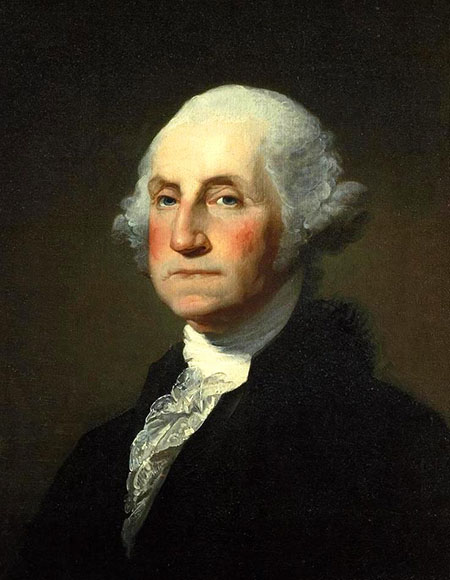
George Washington’s tax on whiskey led to an armed rebellion. Painting by Gilbert Stuart via Wikimedia Commons
In 1787, James Madison expressed the hope that America would have enough “different interests and parties… that no common interest or passion will be likely to unite a majority of the whole number in an unjust pursuit.” But hope is not a plan. Despite all the intricate checks and balances of our Constitution, it has proved inadequate for protecting Americans from government abuse. Also, coalitions of special interest groups have formed, which use the government apparatus to take people’s resources and restrict their freedom of choice.
“In my opinion,” as Alexis de Tocqueville observed, “the main evil of the present democratic institutions of the United States does not arise, as is often asserted in Europe, from their weakness, but from their irresistible strength.” Also, “I do not say that there is a frequent use of tyranny in America at the present day; but I maintain that there is no sure barrier against it, and that the causes that mitigate the government there are to be found in the circumstances and the manners of the country more than in its laws.” But circumstances are bound to change, and the further we move away from the American Revolution in time, the more we lose the spirit of freedom and personal independence which gave birth to it.
The problem is even more pronounced in states that allow initiative legislation. In these states, special interest groups are able to place measures on the ballot, bypassing legislative committees and calendars. If the voters in those states do not respect the rights of their fellow citizens to make their own choices, and to be protected from paying a disproportionate share of taxes, they may be persuaded to vote for propositions whose costs will be borne by others. In other words, where they are in the majority, and the costs of the propositions are borne by a helpless minority.
And that is precisely what Madison meant by “the tyranny of the majority.”
Alan Pyeatt is an award-winning Civil Engineer who lives in Monrovia, California. He also enjoys music, organic gardening, economics, and audio/video production. He has been a member of the Libertarian Party for 30 years, and is currently an Alternate At-Large Rep for the California Executive Committee.
Thanks, and cheers to you, too!
It was a good enough piece…. I was “just saying.” Cheers.
Just saying, as Jill pointed out, on Tuesday we will vote on another sin tax in California. That’s why the piece was written, and that’s why it is timely and newsworthy. My goal is to provide ammunition for people who are opposed to it. Those who are so inclined can post a link on Facebook or email it to their friends.
If you don’t think it’s worth your time, then you have the option to skip it. OTOH, you thought the subject was important enough to post twice on this thread, so maybe it means something to you after all.
FYI, I was re-elected to the executive board of the Libertarian Party of Los Angeles County today. L.A. County has the largest membership of any county in the U.S., and last week we voted to endorse a “no” vote on Prop 29.
BTW, OpEd News also thought the article was newsworthy enough to publish it on their website (http://www.opednews.com/articles/Are-Sin-Taxes-an-Example-o-by-Alan-Pyeatt-120601-135.html). But Jill published it on IPR first. I think that’s kind of cool.
JS @ 8: Proposition 29 is getting quite a bit of discussion on California, and our primary is next Tuesday. Most of us who write here at IPR have time constraints with our jobs and families, so we post as we see fit. Why don’t you become a writer here? Then you can post what you find newsworthy.
@2 & 3 Alternate state committee member of a third party seems an awful tenditious connection to newsworthiness. He is not an elected official or candidate for office or an official party spokesman.
There are scores of millions of Americans registered with neither of the two big parties, are all of their opinions going to be published here too?
Government kills more people per year than tobacco. Where’s the Sin Tax on government?
Government defining sin seems a bit sacreligious, yes?
I’ve no particular quarrel with this piece, but couldn’t we say that ANY and ALL taxes are examples of the tyranny of the majority? Don’t all taxes dissuade some form of behavior?
Gun to my head choice between the current tax regime and a 100% sin tax regime, with some reluctance I’d choose the latter as preferable.
And, yet, there does seem to be something offensive about singling out some dysfunctions for others….
It may clear up this kind of confusion if you also add an introductory blurb as well.
js @ 1: What Paulie said…
The author ” has been a member of the Libertarian Party for 30 years, and is currently an Alternate At-Large Rep for the California Executive Committee.” according to the blurb at the end of the article.
this seems to be an opinion piece on a certain law or “policy,” nothing to to do with independent or third-partisan politics per se.