
By Peter B. Gemma
 There is no free market of ideas, candidates, or political parties on Election Day.
It’s not for a lack of demand. According to the latest ABC News/Washington Post survey, 57 percent of Americans are dissatisfied with the choice between Donald Trump and Hillary Clinton; 44 percent say they would prefer a third-party candidate to run. A recent Associated Press/University of Chicago poll revealed that 71 percent of millennials want an alternative to the Republican and Democrat nominees.
In another survey, Public Policy Polling matched “a giant meteor hitting the earth” against Clinton and Trump. The killer asteroid nabbed 13 percent of the vote, far more than any third party now ballot qualified.
The establishment parties benefit from strict ballot access laws that make it difficult for alternative candidates to participate in elections. In order to get on the ballot, independent and third party candidates must meet a variety of byzantine state-specific filing requirements. Complex stipulations and regulations determine whether voters will be able to choose from a larger pool of parties and candidates.
Unorthodox candidates must undergo bureaucratic and burdensome trials in all 50 states before they are permitted to run for office. And the laws have proven effective: no independent or third party presidential candidate has won an electoral vote in 48 years.
To get on the ballot nationwide this year, it is estimated that a maverick presidential candidate must have more than 880,000 signatures on petitions. The major parties regularly challenge the legitimacy of ballot access petitions (leaving out a middle initial is among many reasons that a name can be considered invalid), so securing a ratio of two-to-one of the required number of signatures is the pragmatic strategy for campaigns. That means an army of petitioners going door-to-door should collect about 1.76 million names in 2016. If that becomes difficult to manage, a candidate may hire professional solicitors who charge $2.50-$5.00 per signature. You do the math.
Consider how the ballot access system currently works: Texas requires independent candidates 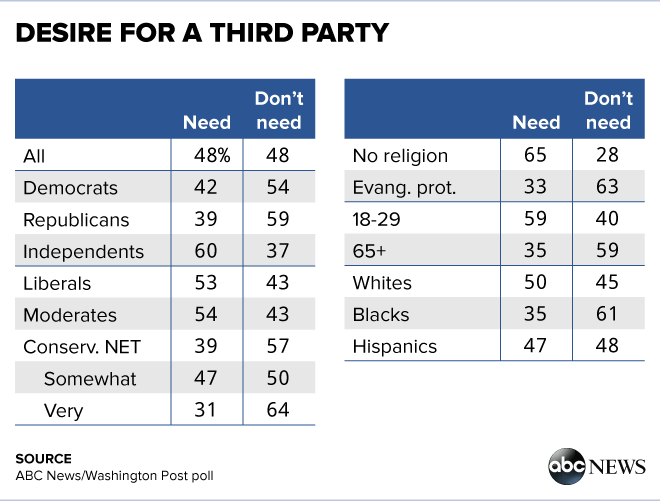 to collect 79,939 signatures (but double that number to be prudent); to become a recognized political party in North Carolina, signatures equal to two percent of the previous gubernatorial election are necessary – that adds up to 89,336 names (secure about 180,000 to be on the safe side); West Virginia demands 6,706 signatures on ballot access petitions if you want to run for the White House (please turn in twice that amount.) Candidates also pay a hefty filing fee of $2,500.
Nine states don’t even allow voters to write-in names of their preferred candidates.
The Libertarian Party beat Oklahoma’s tightly controlled process by obtaining more than 42,000 signatures. The petition campaign cost the national party $104,000. For third parties, organizational infrastructure, as well as deep pockets, is vital – running for President means conducting 50 races simultaneously. Start-up campaigns simply do not have the money or the manpower to be competitive with Democrats and Republicans because of the barriers the ruling parties have put in place.
The nation’s leading expert on ballot access laws is Richard Winger, editor of Ballot Access News. He maintains that, “Ballot access restrictions vary from state to state, but they have one thing in common and that is to prevent people other than Democrats and Republicans from getting on the ballot.”
Disenfranchising candidates is part of the election game as well. Forty-five states have enacted “sore loser” laws denying defeated candidates the right to run a third party or independent campaign. If a candidate believes political power brokers have quashed any chance to win the Democrat or Republican nomination, there is no second chance.
Third party candidate Ralph Nader has observed, “If we all have an equal right to run for election. If they call third-party candidates spoilers but they don’t call their major opponent in the other party a spoiler, they are assigning a second-class citizenship to the third-party candidacy.”
The Gallup organization has found that, “A majority of Americans, 60 percent, say a third major political party is needed because the Republican and Democratic parties ‘do such a poor job’ of representing the American people.” Yet when voters get inside the polling booth, they often find only two candidates listed. Richard Winger asserts, “The extreme disparity of the burdens placed on old, established parties versus new parties has no parallel in any other democratic nation in the world.”
Reasonable ballot access requirements to set qualifying standards are necessary. However, just as poll taxes were set up to keep certain citizens from expressing their right to vote, today’s ballot access laws are deliberately designed to provide a similar obstacle for freethinkers who challenge the political power elites.
In 1775, John Adams warned future generations of American voters that, “There is nothing which I dread so much as a division of the republic into two great parties, each arranged under its leader, and concerting measures in opposition to each other. This, in my humble apprehension, is to be dreaded as the greatest political evil under our Constitution.” He was so right.
___
This article appears at Op/EdNews.com, September 1, 2016
All ballot access laws are censorship.
https://independentpoliticalreport.com/2017/04/d-frank-robinson-censorship-the-state-monopoly-of-ballot-printing/
If Giant Meteor were on the ballot, I might consider it.
Jeff, there are already states where Democrats and Republicans have to gather petition signatures to get on primary ballots.
So then the question is, how would the respective parties control which candidates get to participate in their primaries/conventions to take advantage of the team signature gathering perk? That’s where successful parties will have clearly defined rules (and platform positions/philosophies) that are especially locally driven by their county organizations. Successful candidates will work their way from the bottom up rather than buying their way in from the top down.
What we need is to completely eliminate all of the filing fees and require ALL candidates, Republicans and Democrats alike, to petition for ballot access with the exact same requirements as alternative parties. Every state should have a petition requirement to qualify the party for each particular election year so that they can hold either a convention or a primary. If the party chooses to hold a statewide primary, they must pay 100% of the cost (or split with other parties that do the same) with zero taxpayer dollars involved. Thus the purpose of the political parties will just be to coordinate the signature collection projects. Individual candidates can still petition as unaffiliated (“independent”) with significantly lower petition signature requirements than for a full party. LEVEL THE PLAYING FIELD!
Yes, the system is of course rigged for the rich and powerful to get into office. I hope Evan McMullin gets on the presidential ballot in all 50 states as an independent by bringing up this injustice. I never sign my middle initials (since I have two) that is an absurd rule.