

Naturally, no sooner did I post this than the October numbers appeared, requiring some restatement. I will not hide the past, but please see my comment below.
There are claims that the Mises takeover of the LNC has led to a considerable drop in national party membership. Data do not appear to support these claims. First, courtesy Ken Moellman, we have a graph of membership numbers for the last four-and-a-half Presidential cycles. The horizontal axis covers four years; the vertical axis is the number of party members. At the left-hand edge, the five curves from top to bottom are 2004-2007, 2020-2023, 2008-2011, 2012-2015, and 2016-2019.
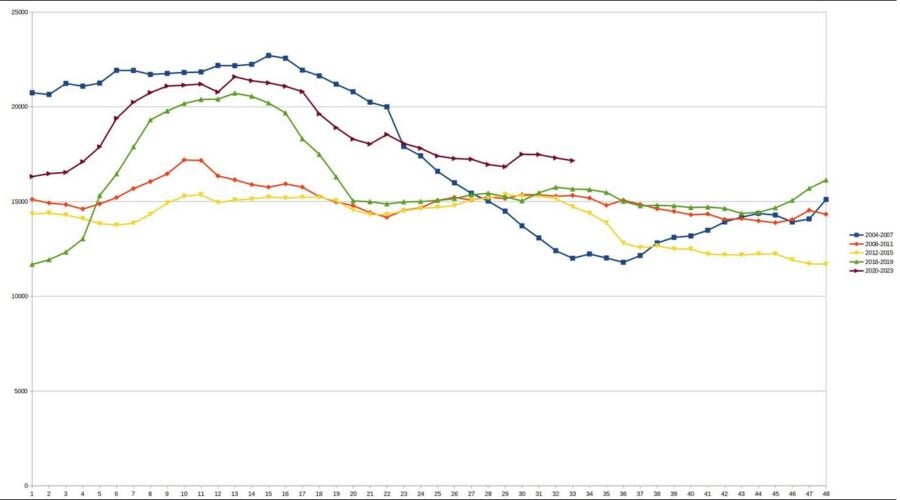
The Presidential election happened to the left of the graph, roughly where some of the curves have peaks. From top to bottom, the 2004 Badnarik campaign started with the most members, but as years advanced the membership count hit rock bottom. The Barr and first Johnson campaign did almost nothing for membership; the curves are flat. The second Johnson campaign gave a large but transitory boost to membership. Within a year the membership count was back to the Barr and first Johnson numbers. The Jorgenson campaign — the line that only reaches part way across the graph — gave an initial boost to membership, but those members are hanging on. The upward lift near the right end of the graph is the month after the national convention.
Second, courtesy of LNC Treasurer Todd Hagopian, we have a chart of membership numbers, drops and adds, month by month. You can read the table, prepared by the LNC’s staff, at this link.
We have counts by month of people dropping, renewing, or becoming new donors, both for the past year, and for December of the four years previous. The most recent month reported is September 2022.
The number of people dropping, renewing, or becoming new donors fluctuates a great deal from month to month. However, the number of members who lapsed/dropped was considerably larger from last September through January 2022 than it has been since. After January, the lapse/drop rate came down by perhaps a third and stayed there. There was not a spike in members leaving the party after the national convention.
The number of new members has a spike immediately after the convention and another in September 2022.
The number of members renewing was higher in the two months adjoining the national convention, and then went down again. The renewal rate in the three most recent months is lower than it has been previously.
Zero dues as implemented in 2005 of 2006 was different from the zero dues option that always existed. In reality the party does not advertise a zero dues option, although it does exist. They just count expired paid members as zero dues members, which they technically are unless they formally revoke their pledge signature, which almost no one ever does. Past members generally don’t realize that they are still zero dues members. The zero dues in 2005 or 6 included LP news and other typical benefits of paid membership, hoping people would donate as much or more. It did not work.
The paid membership did not continue to rise in the early 2000s. It peaked in 1999 between 33 and 34k.
There has always been a zero dues option (Signature Membership).
Aside from the normal post-presidential decline, the drop after 2000 was mostly due to the end of Project Archimedes. There was, at one point, an email discussion between LNC members of the weak internals of Project Archimedes. It was about how only a tiny percentage of the mailing recipients were becoming members, and only a tiny fraction of those were renewing. The only reason the membership numbers kept going up into mid 2000 was because they were sending out larger and larger batches of mailings. I wish I could find that discussion, again, but it isn’t in the place I thought I remembered finding it.
They also tried some bad ideas like going to zero dues and then 50 a year or maybe the other way around. Either way a lot of people stopped paying at that point. If you go back a few years earlier a lot of members dropped after 9/11, BCRA (McCain-Feingold) and the removal of the Browne-Willis-Dasbach leadership team of the party over the previous decade plus, project Archimedes and internal ethics issues. Even earlier there was the popping of the dotcom bubble in 1999. That was the membership peak of 33 k plus. It declined after that before getting stuck in the low teens to low 20s range for the entire period covered by the graph in the article above, spanning almost the last 20 years.
That was the end of the Unified Membership Program. 45 states joined it over a period of several years beginning in 1995 and it ended for all of them on September 30, 2005.
It was a joint membership program between the states and national. Instead of someone having to join the national party with a $25 donation and then separately their state party with another $25 donation (or whatever their state charged) one single $25 donation covered both memberships. For the states that joined, $12 would go to the state and national would keep the remainder.
That worked out really well for the state parties as national took over most of their fundraising costs and gave them a steady income. But, it basically bankrupted the national party. It also irritated some libertarians who only wanted to join their state party and not national.
So the UMP took all of the people who normally only donated to their state party and counted them as national party donors. It also took all of their donations and ran them through the national party before national sent a portion back to the states. That made the headline numbers put out by national for both total donors and revenue look great. But many of those people were only donating half as much to the total party ecosystem.
As national went broke, the program was scrapped. And since a donation makes someone a member for 12 months, it took 12 months for the donor count of people who only wanted to donate to their state party to be rolled off.
The period at the beginning of 2005 is just the normal post-Presidential year decline.
What happened in the 2005/06 timeframe?
Thanks for the figures, George.
Wait–This actually tracks donors, yes? That was authorized by my family via the Libertarian Party Project Group of the LIO at to 50K pending LP doing certain things. It attained this once then lost focus during 2001 because of 9/11 reporting changes, then everyone tried after I left to re-invent the flat tire, new platform, no political director, etc. They did do a good job finding retired politicians/distinguished activists to run on a signature (i.e. needing a push) issue /relationship building defined by LNC e.g. Gov. Johnson on pot legalization, then Social Security in 2020. Probably overdue for a Democratic Governor.
Still, the LP is Up-and-Out and the informal Tiger Team which really runs the show will drain them when over 20 K to other parties. This is often notional as people tend this way anyway and the current donor/member training and welcome structure, starting with NO family memberships, has some improvability. in that it incentivizes people to move on…and I don’t see a post-LP training/to-do structure as they rejoin other parties.
LNC should per past policy be putting life memberships and as much as it can in independent endowments to see core things happen: Candidate training/recruitment especially for local and adlective offices; direct democracy in states/end ballot access statutes; tables and events to sign people up to the NAP; filing friend-of-court briefs and fundraising on those…those were the main ones. NOT making donations to candidates who should be:
a) Fundraising and more importantly knocking on doors/building d-base all by themselves and
b) Building d-base to be shared with LP. with candidate training for that–no one will do that if not trained to do so.
Not sure that is occurring beyond the elementary core activity and reserve policies. So overall LNC/state boards have to be careful of being run by preventable funding imperatives. These are all ideals, however. LP is there to provide a venue of familiarization with various skills as evidenced by maintaining a Dallas-Accord compliant website, conventions/campaigns, conferences, RRO/experience in administering a political group basics, virtues of localism, etc. This is happening and people learn more than they realize.
In contrast, LP members are those who’ve taken the membership certification/Libertarian Pledge for beginner students or NAP. That membership is free. LP supporters are folks getting an e-letter/on social media…How well are they tracking that? I would like to know/see figures. They should be at least 300K and 1MM respectively. Are they doing a yearly ping to be sure they’re alive? That’s why Libertarian International Organization recruited by self-directive homes/families. Stability , self-expansion, plus less pings.
I look forward to their plans to increase donors/certified members.
Having said that, we now have the October membership numbers. You can see them at https://11484554196470929702.googlegroups.com/attach/146d731879465/MEMBERSHIP-OCT-22.pdf?part=0.1&view=1&vt=ANaJVrE2b5KDqIQD3YUFEBxjtOAKXOgARIIM7ED–RKQdAbP0TaUhNZkma-VJBC9bF5S6jOJDyzA6l8K8djI0kDw_7jYvaTNj-zpgrJALtXp02QFVJWfutc.
On the bright side, renewal numbers are well up. 1093 renewals is the highest in a year, and close to twice the numbers seen over the Summer. The number of new donors, month to month, is scattered, but 372 is a respectably large total. However the number of memberships that lapsed or were dropped is 1697, far above even last month’s 1084. Some of this number may be interpreted in terms of the spike in new members a year ago, 690 of them, but even assuming they all dropped the drop among the remainder of the membership was not small. The net result is that membership fell month-to-month from 16874 to 16640 and over the year from 18129 to 16640.