
h/t http://www.kennedyseat.com/
Joe Kennedy’s website: http://joekennedyforsenate.com/
Previous IPR coverage: Martha Coakley, Scott Brown, Joseph Kennedy agree to series of debates in race for Ted Kennedy’s Senate seat
Rich Rubino at Politics DMZ: ‘Yes, Joe Kennedy can win the Massachusetts U.S. Senate Race’
Matt Viser has a two page article about Joe Kennedy in the Boston Globe..
The article begins:
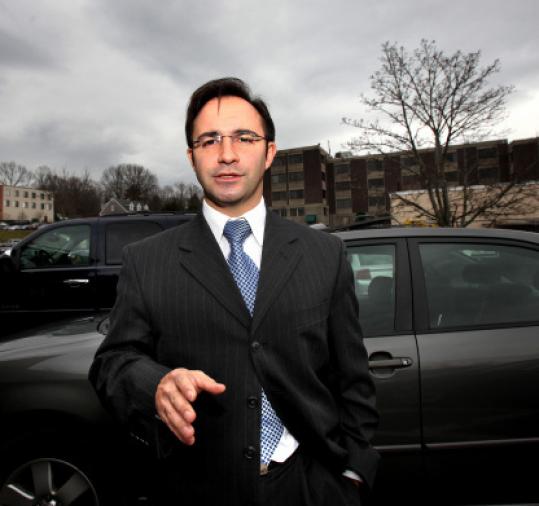
His campaign headquarters are in his home. No one on his campaign staff works full time, and he cannot afford to pay them anyway.
He can hardly believe he’s on the ballot himself.
Meet Joseph Lewis Kennedy, who wants to be your next US senator.
Kennedy, a 38-year-old information technology executive from Dedham, is waging a quixotic independent bid for the seat that became vacant when Edward M. Kennedy (no relation) died in August. He is an active Libertarian and advocates a diminished role for the federal government.
“I’m not an attorney general, and I’m not a state senator,’’ Kennedy said, alluding to the Democratic nominee, Attorney General Martha Coakley, and the Republican nominee, state Senator Scott P. Brown.
“I have a desk that I go to every day, and I know what people who pay taxes care about,’’ he said. “I’m that guy, too.’’
Kennedy’s candidacy, once thought to pose a possible problem for the Democratic nominee simply because of the political appeal of his name, has been seized on for strategic advantage by Coakley and is now a potential thorn in the side of Brown.
Viser goes on to say,
Kennedy’s candidacy has been the hot topic in the early stages of the Jan. 19 special election, largely overshadowing any discussions of Afghanistan, health care, and domestic economic policy.
Republican Scott Brown is quoted as saying
I have to be honest with you, I don’t know anything about him. I didn’t know until this weekend that he was even on the ballot […]
As far as I could tell, the rest of the article is accurate, except that it claims that Kennedy is on the Libertarian National Committee, whereas he is actually only on the party’s State Committee and is a regular member of the national Libertarian Party.
Globe reporter Viser’s view that “Kennedy’s candidacy has been the hot topic in the early stages of the Jan. 19 special election” appears to be borne out by the coverage at non-partisan blog Kennedy Seat, which covers all three candidates in the race. In this morning’s roundup, 3 of 4 items were about Kennedy.
Joe is also currently dominating the google news top search results for “libertarian,” “independent candidate,” “Joe Kennedy” and “Kennedy,” eclipsing (at least for the time being) Joseph P. Kennedy and the Kennedy “clan.”
As Shakespeare asked, “What’s in a name?”
Despite the fact that there was also a significant third candidate in that field, too, the January 19 special election in Massachusetts bears little resemblance to the three-cornered 1962 special election that sent the late Edward M. Kennedy to the U.S. Senate.
In addition to Ted Kennedy and Republican George C. Lodge, Harvard professor H. Stuart Hughes, a longtime peace activist and historian who spoke out for nuclear disarmament and against the Vietnam War and later co-chaired the National Committee for a SANE Nuclear Policy with Dr. Benjamin Spock, also entered the 1962 special election for the U.S. Senate as an independent candidate after collecting a staggering 117,636 petition signatures — 45,136 more than the 72,500 necessary.
An agnostic, Hughes was an unorthodox candidate by almost any measure. Running hard to Kennedy’s left, the tall and pedantic professor admitted sympathy for “democratic socialism” and advocated a higher minimum-wage, universal health care and a 35-hour workweek.
Unfortunately, the scholarly Hughes failed miserably in trying to present himself as a genuine “Citizen Candidate,” an ordinary guy without gobs of money — something that Joseph L. Kennedy appears to be doing successfully, at least based on newspaper reports.
Despite having a famous name himself — he was the grandson of Supreme Court Chief Justice Charles Evans Hughes — the Harvard professor also had the misfortune of running against two major-party candidates with equally famous names: Edward M. Kennedy, the President’s younger brother, and Republican George C. Lodge, son of former U.S. Senator and UN Ambassador Henry Cabot Lodge, Jr.
Unlike the 1962 contest, the January 19 special election features only one famous name — Joseph L. Kennedy….and with that comes a once-in-a-lifetime opportunity.
Stranger things have happened.
In any case, Kennedy borrowed heavily to get his name on the ballot and George Phillies and the folks in Massachusetts have done almost everything they can financially. They need our help. I know the economy is terrible and the holidays are upon us, but every Libertarian and libertarian-leaning activist should consider contributing to his campaign. So, too, should everyone in the IPR community.
What’s in a name? We may find out on January 19th!
Ah, that explains it. Makes replies look weird out of context tho 🙂
I deleted my comments. I have a habit of typing without really thinking first.
Something weird happened, the comment from Morgan I responded to in what is now #4 seems to have disappeared.
As for the negativity – I just don’t see it, in the excerpt or elsewhere. It sticks to the facts, other than the one factual error I found.
I guess it just sounded a bit negative from the excerpts.
I don’t see anything negative in it. Do you?
This is a superb article and excellent coverage. We should be delighted to see it.
Another one from the Globe,
“Joe Kennedy on the issues”
http://www.boston.com/news/local/massachusetts/articles/2009/12/18/joe_kennedy_on_the_issues/
Their coverage seems to be getting better.